
History of The Musical Stage
The 1930s I: Great Songwriting Teams
by John Kenrick
(Copyright 1996 & 2003)
(The images below are thumbnails – click on them to see larger versions.)
Troubled Times
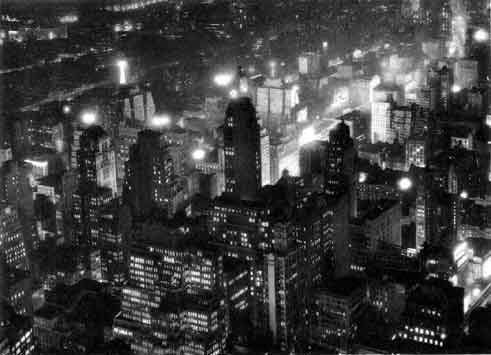 Ever wonder why
Broadway is called "The Great White Way"? This vintage postcard gives an aerial view of Manhattan's
glowing theatre district in the 1930s.
Ever wonder why
Broadway is called "The Great White Way"? This vintage postcard gives an aerial view of Manhattan's
glowing theatre district in the 1930s.
When the last vaudeville bill closed at New York's Palace Theatre in 1932, some feared that Broadway theatres faced a similar fate. Stage musicals were charging three dollars for an orchestra seat at a time when many people could not afford a five cent movie admission. By 1935, investment dollars were so hard to find that Broadway did not see its first new musical of the year until late May. With the Great Depression at its worst and many going hungry, how could Broadway hope to survive?
Some producers complained that films (average admission in 1935 was 25 cents) were taking away the audiences that used to attend live theater, but that was not the whole truth. A 1932 study commissioned by Actor's Equity suggested that:
". . . movies largely created their own audiences . . . (and) would not have hurt the legitimate theater appreciably had its internal conditions been sound."
- Alfred Bernheim, The Business of the Theater (1932 - reprinted by Benjamin Blom Inc., NY, 1964), pp. 85-86.
Since most of Lee and Jacob Shubert's theaters stood on prime urban real estate all across the US, advisors urged them to sell off all or part of the chain and invest in other businesses. In a daring move, the Shuberts declared bankruptcy to clear their corporate debts. Then Lee Shubert dug into his personal savings to re-purchase the corporate assets at a fraction of their old value, including all the theatres. After taking primary control of the company (and reducing his hated brother Jacob to a frustrating supportive role), Lee spent millions more to produce shows and keep the theaters open. Thanks to this investment, theatres all across the United States were preserved and the professional theater survived the Great Depression.
Despite extraordinary financial and political turmoil, the 1930s saw the Broadway musical reach new creative heights. As Stanley Green, the dean of musical theatre historians has explained it:
"The musical theatre – the most opulent, escapist, extravagant, and unabashedly commercial form of the theatre – could not hide from what was going on. Of course, it could still provide relief from reality. It could still offer evenings of mirth and song and glamour. But it showed a growing awareness of its own unique ability to make telling comments on such issues of the day as the folly of war, municipal corruption, political campaigns, the workings of the federal government, the rising labor movement, the dangers of both the far right and the far left, and the struggle between democracy and totalitarianism. It discovered that a song lyric, a tune, a wisecrack, a bit of comic business, a dance routine could say things with even more effectiveness than many a serious minded drama simply because the appeal was to a far wider spectrum of the theatergoing public."
- Stanley Green, Ring Bells! Sing Songs!: Broadway Musicals of the 1930s (New Rochelle, NY: Arlington House, 1971), p. 12.
The Gershwins
 William
Gaxton, Lois Moran and Victor Moore as
they appear on the original cast Playbill cover for Of Thee
I Sing.
William
Gaxton, Lois Moran and Victor Moore as
they appear on the original cast Playbill cover for Of Thee
I Sing.
George and Ira Gershwin turned out six musicals in the 1930s, displaying a wider artistic range than any other team at that time. Their hits included –
Strike Up the Band (1930 - 191 performances), a political satire that had the United States and Switzerland go to war over high chocolate tariffs. The jaunty title march and the ballad "I've Got a Crush on You" became popular favorites.
Girl Crazy (1930 - 272 performances) told of a rich New York playboy falling in love with an Arizona cowgirl. The show starred Ginger Rogers but was stolen by Ethel Merman, a stenographer from Queens who made a sensational Broadway debut belting out "Sam and Delilah" and "I Got Rhythm."
Of Thee I Sing (1931 - 441 performances) was the longest running Broadway book musical of the 1930s. The Gershwins worked with script writers George S. Kaufman and Morrie Ryskind on this satirical tale of a President who gets elected (and almost impeached) because he marries the woman he loves. Several scenes were set to music in a semi-operatic format, but the score was pure musical comedy. The Gershwin score included "Who Cares," "Love Is Sweeping The Country" and the martial title tune. Starring William Gaxton and Victor Moore (pictured above), Of Thee I Sing was the first musical ever to win the Pulitzer Prize for drama.
After two quick failures, the Gershwins gave Broadway a unique jazz opera.
For Porgy and Bess (1935 - 124 performances) the Gershwins teamed with playwright DuBose Heyward to adapt Porgy, his novel and hit play (co-adapted by wife Dorothy Heyward) about poor blacks living in the dockside tenements of Charleston. It had passion, infidelity, rape and heartbreak -- all the makings of grand opera. George Gershwin's score offered a singular blend of classical, popular and jazz styles that was possible only on Broadway. Most Depression-era critics and theater goers were less than enthusiastic about such a serious show, so the original production was a financial failure. But Porgy and Bess became more popular over time, with acclaimed Broadway revivals in 1942 (286 performances), 1952 (305 performances), and 1976 (129 performances). In 1985, it became the first Broadway musical to enter the repertory of The Metropolitan Opera Company. It seems some triumphs are so great that it takes fifty years for them to set in.
George Gershwin was working in Hollywood when he died due to a brain tumor in 1937. We can only imagine what he might have contributed to musical theater and film had he lived longer. Although heartbroken, Ira would work on many important stage and screen scores through the 1950s, so his name re-appears in the pages ahead.
Rodgers and Hart
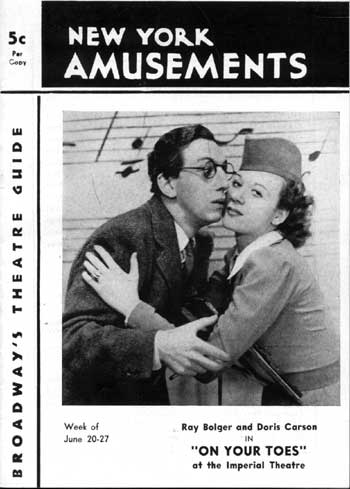 Ray
Bolger and Doris Carlson starred as the music-loving lovers in Rodgers and
Hart's On Your
Toes (1936) -- seen here on the cover of an entertainment guide
distributed in the 1930s.
Ray
Bolger and Doris Carlson starred as the music-loving lovers in Rodgers and
Hart's On Your
Toes (1936) -- seen here on the cover of an entertainment guide
distributed in the 1930s.
Hollywood had made little use of Richard Rodgers and Lorenz Hart in the early 1930s. After one of their songs was cut from several films, they arranged for it to be recorded independently -- "Blue Moon" immediately out-sold any song they had written for the screen. Soon afterward, the duo returned to Broadway to write a string of musical comedy hits. In each case, a lighthearted script was sprinkled with marvelous songs, some integrated into the action and some not. Comfortably enriching traditional musical comedy with innovative flair, Rodgers and Hart were at the top of their game.
Jumbo (1935 - 233 performances) was a circus spectacle staged in the massive Hippodrome Theatre. It featured a live elephant, expert clowning by Jimmy Durante, and the hit songs "The Most Beautiful Girl in the World" and "My Romance." Tickets sold well, but producer Billy Rose's record-setting $340,000 budget made it impossible for the production to turn a profit.
On Your Toes (1936 - 463 performances) starred Ray Bolger as a classical music professor (and former vaudeville dancer) who finds himself entangled in the world of classical ballet. This was the first Broadway musical to make dramatic use of classical dance. Choreographer George Balanchine staged several numbers, including the "Slaughter On Tenth Avenue Ballet." The score boasted "There's a Small Hotel" and "Its Got to Be Love."
Babes In Arms (1937 - 289 performances) had stage struck teenagers putting on a show to raise money for their impoverished vaudevillian parents. Alfred Drake and The Nicholas Brothers were in the youthful cast, and the hit-drenched score included "My Funny Valentine," "Where or When," "Johnny One Note" and "The Lady is a Tramp."
I'd Rather Be Right (1937 - 290 performances) was a political satire starring George M. Cohan as a singing, dancing President Franklin Roosevelt. The most memorable number was "Have You Met Miss Jones?"
I Married An Angel (1938 - 338 performances) told of a Hungarian count who finds his prayed-for marriage to an actual angel ruined by her unfailing honesty.
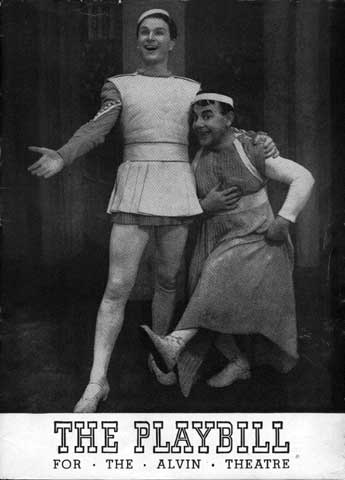 Eddie
Albert and Jimmy Savo are both about to encounter their long lost twins, setting off a storm of mistaken
identities in The Boys From Syracuse (1938). Savo's twin was
played by Larry Hart's brother Teddy, who bore a striking physical
resemblance to Savo. Few subsequent casts have been able to offer actors bearing even a vague
similarity in appearance.
Eddie
Albert and Jimmy Savo are both about to encounter their long lost twins, setting off a storm of mistaken
identities in The Boys From Syracuse (1938). Savo's twin was
played by Larry Hart's brother Teddy, who bore a striking physical
resemblance to Savo. Few subsequent casts have been able to offer actors bearing even a vague
similarity in appearance.
The Boys From Syracuse (1938 - 235 performances) was an adaptation of Shakespeare's The Comedy of Errors, with two sets of long-lost identical twins getting caught in hilarious identity mix-ups in ancient Greece. Rodgers & Hart's superb score included "Sing for Your Supper" and "Falling in Love With Love." Eddie Albert made his musical debut singing "This Can't Be Love."
Too Many Girls (1939 - 249 performances) featured newcomers Desi Arnaz, Eddie Bracken and Van Johnson as college football stars hired to protect a millionaire's freshman daughter. The songs included "Give It Back to the Indians" and "I Didn't Know What Time It Was."
As director and librettist, George Abbott was a major contributor to five Rodgers & Hart hits. His fast-paced staging and naturalistic comic dialogue set the tone for American musical comedy from the 1930s right into the 1960s. A no-nonsense director, he was not afraid to introduce new elements and new talents to musical theater, and would be part of dozens of hits in the years to come.