
History of Musical Film
Screen 1950s: Three Final Classics
by John Kenrick
(Copyright 1996-2003)
(The images below are thumbnails click on them to see larger versions.)
Three more magnificent musical films belong on the list of all-time greats. Although filmed by three different studios, all were created by alumni of Arthur Freed's legendary production unit at MGM.
Funny Face
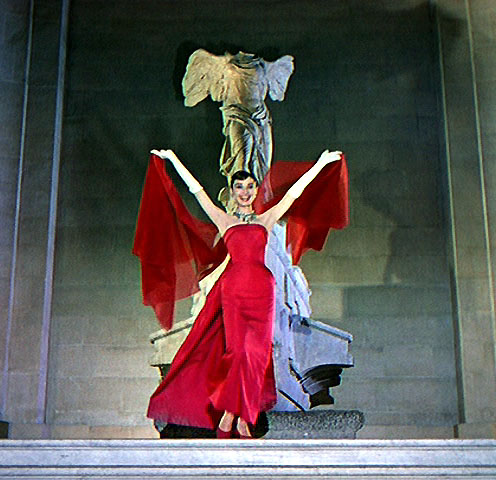 Funny Face (1957) was conceived at MGM,
but when Paramount refused to loan out
Audrey Hepburn, several key members of the Freed unit (who
knew they were in the process of being disbanded) made the film at Paramount. Arthur Freed's longtime associate
Roger Edens produced,
Stanley Donen directed, and singer-composer
Kay Thompson (Edens' longtime MGM colleague) gave a film-stealing performance as a
ruthless fashion magnate. Fred Astaire
made everything from a raincoat to an umbrella come alive as dance partners in
"Let's Kiss and Make Up." The score consisted of four classic George
and Ira Gershwin songs,
with several new numbers by Edens and Leonard Gershe. Hepburn gave a
disarming performance as an intellectual beauty wooed by photographer Astaire
while doing photo spreads for Thompson's magazine.
Funny Face (1957) was conceived at MGM,
but when Paramount refused to loan out
Audrey Hepburn, several key members of the Freed unit (who
knew they were in the process of being disbanded) made the film at Paramount. Arthur Freed's longtime associate
Roger Edens produced,
Stanley Donen directed, and singer-composer
Kay Thompson (Edens' longtime MGM colleague) gave a film-stealing performance as a
ruthless fashion magnate. Fred Astaire
made everything from a raincoat to an umbrella come alive as dance partners in
"Let's Kiss and Make Up." The score consisted of four classic George
and Ira Gershwin songs,
with several new numbers by Edens and Leonard Gershe. Hepburn gave a
disarming performance as an intellectual beauty wooed by photographer Astaire
while doing photo spreads for Thompson's magazine.
Impressive as the cast and score are, Donen's unique sense of cinematic flow makes this film a standout. Every song flows out of the action surrounding it, and unforgettable images abound. Film buffs have long treasured Hepburn's exuberant descent down a staircase in the Louvre, trailing a red tulle wrap in imitation of the sculpture "Winged Victory" (seen in the photo just above). Although visually stunning and thoroughly entertaining, Funny Face was such a box office disappointment that Paramount stopped making musicals altogether, and MGM allowed the Freed unit to fade away. However, the film developed a dedicated following over time.
A Star is Born
Warner Brothers most masterful 1950s musical was built by another stellar team of MGM alumni: director George Cukor, screenwriter Moss Hart, composer Harold Arlen, lyricist Ira Gershwin and performer Judy Garland. The magnificent A Star is Born (1954) was based on a classic 1937 tearjerker about an unknown actress surviving Hollywood stardom and personal heartbreak. After months of long and tortured filming, Garland gave the most unbridled and powerful screen performance of her career, while Cukor and company made "The Man That Got Away" and other songs emotional highpoints that fit seamlessly into the story.
Convinced that A Star Is Born was too long, studio head Jack Warner had 27 minutes cut from all prints soon after the premiere. As a result, most audiences saw a confusing, incomplete film. It was not until an archival restoration in 1983 that the true impact of the film could be appreciated. The "Born in a Trunk" sequence (scored without credit by MGM alumni Roger Edens) had always been praised, but "Lose That Long Face" and other restored scenes feature Garland at her best. That Hollywood's greatest musical star did not receive an Academy Award for her finest performance remains one of the saddest injustices ever perpetrated in an unjust business. (You have to see winner Grace Kelly's pallid work in The Country Girl to know how senseless this particular loss was.)
Gigi: MGM's Finale
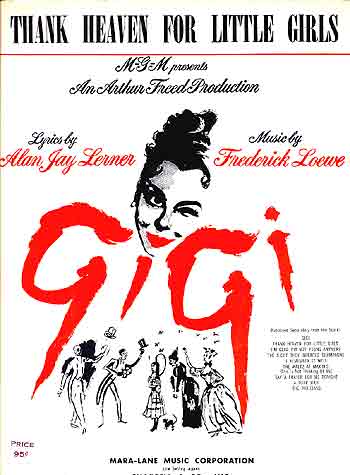 MGM was dismissing it's contract employees, but a defiant
Arthur Freed pulled together one last triumph. At
the urging of director Vincente Minnelli,
Freed called in My Fair Lady's Alan Jay
Lerner and Frederick Loewe
to musicalize French novelist Colette's story of a young girl who is raised to be a
courtesan but manages instead to fall in love with (and marry!) a millionaire. The
result was Gigi (1959).
The cast included Leslie Caron as
the title character, Hermoine Gingold as her
protective grandmother and Louis Jourdan as the
millionaire. Maurice Chevalier, his
roguish charm as irresistible as ever, made a triumphant return to the musical
screen as Jourdan's aging but irrepressible playboy uncle.
MGM was dismissing it's contract employees, but a defiant
Arthur Freed pulled together one last triumph. At
the urging of director Vincente Minnelli,
Freed called in My Fair Lady's Alan Jay
Lerner and Frederick Loewe
to musicalize French novelist Colette's story of a young girl who is raised to be a
courtesan but manages instead to fall in love with (and marry!) a millionaire. The
result was Gigi (1959).
The cast included Leslie Caron as
the title character, Hermoine Gingold as her
protective grandmother and Louis Jourdan as the
millionaire. Maurice Chevalier, his
roguish charm as irresistible as ever, made a triumphant return to the musical
screen as Jourdan's aging but irrepressible playboy uncle.
Gigi had minimal choreography, but the score ("Thank Heaven For Little Girls," "The Night They Invented Champagne," "Gigi") and ingenious screenplay made the potentially unsavory subject matter into a sophisticated yet family-friendly hit. Where other film makers settled for a standard postcard vision of Paris, Minnelli shows the city from the everyday perspective of Parisians. Instead of gazing at the Eiffel Tower from a distance, we travel beneath it; instead of a glittering hotel or romanticized garret, we see such wildly contrasted residences as a dazzling palace interior and a frowsy bourgeois apartment. Minnelli also makes amazing use of light and shadow. In one sequence, a pensive Jourdan is silhouetted against illuminated fountains, communicating a key moment of revelation with a few mute movements – the sort of pure cinematic effect that could never be accomplished on a Broadway stage.
Despite Gigi's tremendous critical and commercial success, MGM's Freed unit passed into history. Producer Arthur Freed and his associates would not receive their full due until the release of That's Entertainment (1974) reminded the world what a rich legacy they had left behind.
"Gigi was Freed's last original musical, and the line begun in The Wizard of Oz and continued through Meet Me in St. Louis, On the Town and Siingin' in the Rain came to an end in one of the ritziest films ever. Here is a musical that uses decor, color, motion, even the juxtaposition of true locale and sound stage, for tone . . . Minnelli makes a movie, as Lubitsch and Mamoulian did when almost no one else knew what a musical was, and as few knew now that musicals were turning into Broadway souvenirs."
- Ethan Mordden, The Hollywood Musical (New York: St. Martin's Press, 1981), p. 198.
Why Are These "The Best"?
The seven 1950s film musicals we've just discussed have two common factors. First, all seven set their musical numbers in the context of everyday life. Gigi has Maurice Chevalier sit in the middle of a bustling city park and sing directly to the camera lens about girls whose beauty can send men "crashing through the ceiling." In the same spirit, Seven Brides for Seven Brothers had a septet of mountain men in the Wild West win feminine attention by kicking up a macho storm at a town dance.
While stage musicals had long since relied on this blend of song with real life activities, it had only been tried on film by a few innovators like Rodgers and Hart (i.e. - in Love Me Tonight's pass-the-song-along "Isn't It Romantic" sequence). Minnelli toyed with the concept in Meet Me In St. Louis, but compromised by presenting most of the songs proscenium-style (framed in windows or doorways) or on a raised space with an audience (the top of a trolley).
Another key issue in these films – the songs were sensational. When Judy Garland sets A Star is Born smoldering with her rendition of "The Man That Got Away," Harold Arlen's music and Ira Gershwin's lyric matter just as much (if not more than) the visually arresting presentation. Whether pain-filled, witty or celebratory, 1950s screen musicals used some of the finest songs in the history of American popular music. (Of course, An American in Paris, Funny Face and Singin' in the Rain resurrected many existing hit tunes, so the songs were actually written over a period of several decades.)
The next decade would bring the most profitable musical films of all time. Almost all would be adaptations of Broadway shows, but there was an occasional "spoonful of sugar" to help the medicine go down.