
History of Musical Film
The 1960s: "A Spoonful of Sugar"
by John Kenrick
(Copyright 1996: revised 2014)
(The images below are thumbnails – click on them to see larger versions.)
Julie Andrews: "The Lady's a Star"
 The Sound of Music
(1965) soundtrack LP sold over 21 million copies and remained on the charts
for over 70 weeks. This familiar artwork is
a clever collage, blending elements that occur in various scenes of the film.
The Sound of Music
(1965) soundtrack LP sold over 21 million copies and remained on the charts
for over 70 weeks. This familiar artwork is
a clever collage, blending elements that occur in various scenes of the film.
Hollywood's top musical star of the 1960s arrived from Broadway -- by means of a flying umbrella. Julie Andrews had every reason to believe that she would reach the big screen recreating her Broadway triumph as Liza in My Fair Lady, but producer Jack Warner rejected her as "not photogenic." (A legendary misjudgment!)
Capitalizing on Warner's stumble, Walt Disney moved quickly to cast Andrews as Mary Poppins (1964), a magical nanny who brings joy to a family in Edwardian London. With a delightful score by Richard and Robert Sherman and a supporting cast that included Broadway veterans Dick Van Dyke, Ed Wynn and Glynis Johns, Mary Poppins was the best live-action musical Disney ever made. Its inventive musical sequences include Andrews magically cleaning house during "Spoonful of Sugar," being serenaded by every animal in an animated barnyard, and cavorting about with Van Dyke on a "Jolly Holiday" with several animated penguins. The film was one of Walt Disney's personal favorites, and according to film critic Leonard Maltin –
"In a way, Mary Poppins is the culmination of Walt's career in that it draws on everything he learned how to do – blending animation and live action, integrating songs with story and of course, not the least, his great eye for talent – because after all he's the one who brought Julie Andrews to Hollywood for the first time to make this film."
– as heard in The Making of Mary Poppins, Disney DVD, 1997.
Mary Poppins won five Academy Awards, the most ever for a Disney production. "Chim, Chim Chiree" won for best song. Andrews won for Best Actress, and had much to celebrate as her next project made her the hottest star in Hollywood.
The Sound of Music
20th Century Fox had driven itself into bankruptcy spending $40 million on the historical epic Cleopatra. Fox moguls Darryl and Richard Zanuck slashed expenditures and searched for a hit to restore their fortunes. They had done well filming Richard Rodgers and Oscar Hammerstein II's stage hits in the 1950s, and already owned the screen rights to the final R&H show. Fox filmed The Sound of Music (Fox - 1965) as their last hope, with a tight $8.2 million budget. It proved to be one of the most popular films of all time, grossing hundreds of millions and garnering five Academy Awards – including Best Picture.
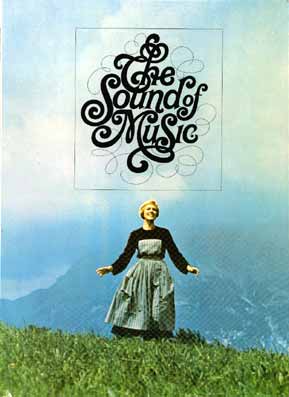 Millions
of movie goers purchased the souvenir book for
The Sound of Music. The cover depicts Julie Andrews singing the title
song amid the Alps just outside of Salzburg.
Millions
of movie goers purchased the souvenir book for
The Sound of Music. The cover depicts Julie Andrews singing the title
song amid the Alps just outside of Salzburg.
The Sound of Music remained in general release for an unprecedented four years. Decades later, it remains a classic, with a wonderful score, critic-proof performances and breathtaking cinematography. Julie Andrews and Christopher Plummer kept the sentiment in check, and many underrate the crucial, edgy performances of Eleanor Parker as the acerbic Baroness and Richard Haydn as Uncle Max.
Detractors who called this film "The Sound of Mucus" missed the point. In this film (and its original stage version), the real bad guys are not the Nazis, but the "decent" people who acquiesce to them. Amid all the sentiment, this musical offers a devastating condemnation of those who empower evil by refusing to actively oppose it. The Sound of Music has been instilling that powerful, timeless idea in several generations of viewers. It will be a lasting source of pleasure and unexpected enlightenment long after its detractors are forgotten. In fact, most of its original critics already are.
Andrews next starred in Thoroughly Modern Millie (1967), a spoof of the 1920s that featured a hilarious farewell performance from stage comedienne Bea Lillie. Although the slightly overlong film fell short of expectations, it did give Andrews a chance to poke fun at her goody-goody image. She had high hopes for Star (1968), a musical biography of stage star Gertrude Lawrence. Ruined by clumsy studio cuts, the film was Andrews' first commercial failure. The restored version now available on video is uneven but fascinating, with Andrews delightful in a series of stupendous musical sequences.
Andrews then played a Mata-Hari-style double agent in Darling Lili (1969), with direction by second husband Blake Edwards and a score by Henry Mancini. Despite some fine moments, the film did not do well. Andrews went on to star in her own musical variety TV series in the 1970s (winning an unprecedented twelve Emmys), and appearing in non-musical films. She would return in the 1980s with one final screen musical. What set Julie Andrews apart? She combined superb vocal technique with insightful lyric interpretations, and her singing voice had a rare crystalline quality. Above everything, she had an unaffected screen presence. Hitting high notes on a Salzburg street corner or in a barnyard full of cartoon animals might have looked ridiculous, but these things worked when Andrews did them.
Elvis
Elvis Presley, the hip-gyrating King of Rock 'n' Roll, starred in thirty musical movies between 1956 and 1970 -- more musicals than any other screen star during the same period. The most memorable titles on the list include Jailhouse Rock (1956), Girls! Girls! Girls! (1962) and Viva Las Vegas (1964). By grafting Presley pop songs onto routine plots (his films made no attempt to integrate song & story), these relatively low budget projects made truckloads of money. Presley's original film songs include the charming ballads "Love Me Tender" and "Can't Help Falling in Love." While these films may not be artistic landmarks, they attracted millions of movie goers – no small accomplishment at a time when musicals were fading from the sceen.
Aside from Elvis projects, most of the Hollywood musicals of the 1960s were Broadway retreads. Why? And were they worth the effort and expense?
Doctor Dolittle: Warning Signs
When the 1960s parade of lavish screen musicals was still running strong, 20th Century Fox's musical adaptation of the classic children's story Doctor Dolittle (1967) gave Hollywood a painful indication of how costly a mismanaged production could be. Budgeted at a then-generous $6 million, casting changes and behind the scenes ego clashes gradually sent costs skyrocketing to over $17 million. Reasonably well received, the film garnered Academy Awards for its special effects and the catchy song "Talk to the Animals." But the overlong film sold few tickets, and its $9 million gross spelled the end of several musical screen careers -- including that of temperamental leading man Rex Harrison.
But other screen musical were raking in the millions -- especially those that had been pre-tested as Broadway hits.