
History of the Musical Stage
1860s: The Black Crook
by John Kenrick
(Copyright 1996; Revised 2020)
(The images below are thumbnails – click on them to see larger versions.)
Accidental Birth
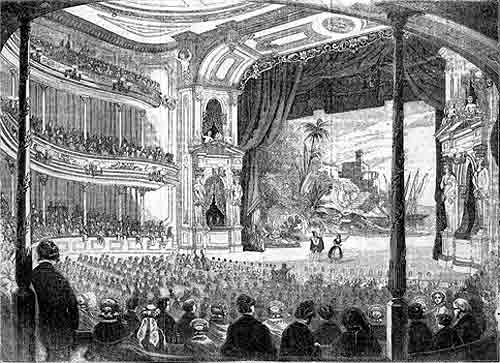 The
ornate interior of Niblo's Garden as seen in an
1855 newspaper sketch. Actors needed solid vocal technique to be heard in this
3,200 seat auditorium.
The
ornate interior of Niblo's Garden as seen in an
1855 newspaper sketch. Actors needed solid vocal technique to be heard in this
3,200 seat auditorium.
In the summer of 1866, lower Broadway was New York City's busiest thoroughfare, at least as congested with traffic as it is today, but with temperamental horses and piles of manure added to the chaos of vehicles and people. As post-Civil War business boomed, there was a sharp increase in the city's working and middle class population, and these growing masses of people craved entertainment.
Theaters abocropped up all over Manhattan island. One of the most popular was Niblo's Garden, a 3,200 seat auditorium at the corner of Broadway and Prince Streets that boasted the most well equipped stage in the city. Its manager was William Wheatley, a sometime actor who would invent the big-time Broadway musical. He wasn't looking to invent anything. He was just trying to keep his theater in business.
With the fall theatre season just weeks away, Wheatley was stuck. He held the rights to a dull melodrama that he hoped to sweeten with lavish production values and a stack of mediocre songs by assorted composers.
Salvation came in the form of a fire that destroyed New York's elegant Academy of Music, leaving promoters Henry C. Jarrett and Harry Palmer with a costly Parisian ballet troupe and a shipload of handsome stage sets. Historians argue about specifics, but at some point Jarrett, Palmer and Wheatley made a deal, and Broadway's first mega-hit musical began to take shape.
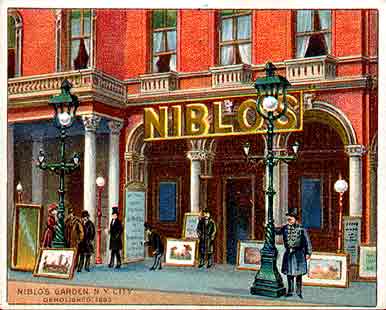 The
entrance to Niblo's Garden was depicted on this mid-20th
Century cigarette card.
The
entrance to Niblo's Garden was depicted on this mid-20th
Century cigarette card.
When playwright Charles M. Barras objected to having his dull and derivative play "cheapened" by the inclusion of musical numbers, a $1,500 bonus secured his silence. Wheatley later claimed that he spent the then-unheard of sum of $25,000 to produce The Black Crook (1866 - 474 performances). The opening night performance on September 12 lasted a bottom-numbing five and a half hours, but the audience was too dazzled to complain.
The Black Crook's hodgepodge plot stole elements from Goethe's Faust, Weber's Der Freischutz, and several other well-known works. The evil Count Wolfenstein tries to win the affection of the lovely villager Amina by placing her boyfriend Rodolphe in the clutches of Hertzog, a nasty crook-backed master of black magic (hence the show's title). The ancient Hertzog stays alive by providing the Devil (Zamiel, "The Arch Fiend") with a fresh soul every New Year's Eve.
While an unknowing Rodolphe is being led to this hellish fate, he selflessly saves the life of a dove, which magically turns out to be Stalacta, Fairy Queen of the Golden Realm, who was masquerading as the bird. (Still with me?) The grateful Queen whisks Rudolphe to safety in fairyland before helping to reunite him with his beloved Amina. The Fairy Queen's army then battles the Count and his evil horde. The Count is defeated, Satan's demons drag the magician Hertzog down to hell, and Rodolphe and Amina live happily ever after.
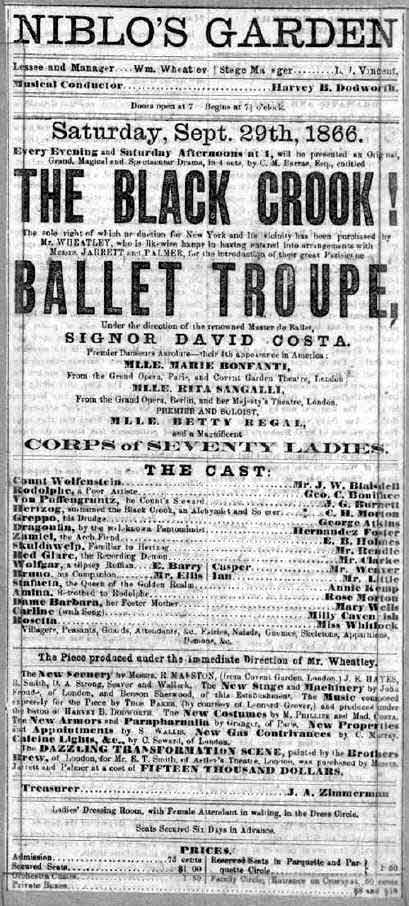 The original cast program
for The Black Crook.
The original cast program
for The Black Crook.
Wheatley made sure his production offered plenty to keep theatergoer's minds off the inane plot and forgettable score. There were dazzling special effects, including a "transformation scene" that mechanically converted a rocky grotto into a fairyland throne room in full view of the audience. But the show's biggest draw was its underdressed female dancing chorus, choreographed in semi-classical style by David Costa. Imagine a hundred well-fed ballerinas (the fashionable look at that time) in skin-colored tights singing "The March of the Amazons" while prancing about in a moonlit grotto. In 1866, this display was the most provocative thing on any respectable stage. The troupe's prima ballerina, the suprisingly petite Marie Bonfanti, became the toast of New York.
Click here to see a script sample from:
The Black Crook
Why a Landmark?
Controversy sells tickets, so righteous attacks from pulpits and newspaper editorial columns helped to make The Black Crook the hottest ticket on Broadway. Half-clad women? Who could miss seeing such a daring display! At a time when New York productions were happy to run two or three weeks, The Black Crook ran for more than a year, becoming the first American stage production to gross over a million dollars. New tours popped up for decades to come, and the show was revived on Broadway eight times. Over time the material was heavily revised and the songs replaced. A 1920s tour costumed the fairy army as Jazz-age flappers.
So why did The Black Crook become such a phenomenon, when a similar hit from six years earlier was quickly forgotten? The Seven Sisters (1860) starred Laura Keene (a top actor-manager of the day) and ran for a then unheard of 253 performances. It featured the same sort of magical special effects and scene changes (a.k.a. "Transformation scenes"), and delighted audiences of all classes and ages. No copies of the Seven Sisters score or libretto are known to survive, so direct comparisons are impossible. However, we can say that The Black Crook's greater success resulted at least in part from two changes brought about by the Civil War --
- After running businesses
and hospitals during the war years, respectable women no longer felt tied to
their homes and could attend the theatre. This substantially increased the
potential audience for popular entertainment throughout the United States. Even so, some
women sat through The
Black Crook heavily veiled to maintain their reputations.
- America's railroad system had expanded and upgraded during the war, making it easier and more affordable to tour with elaborate sets and costumes. During three-plus decades of touring the United States, The Black Crook earned millions of dollars.
British theatre historian Sheridan Morley (Spread A Little Happiness. New York: Thames and Hudson, 1987, p. 15) suggests that The Black Crook was the first musical, American or otherwise. While that is debatable, The Black Crook did prove how profitable the musical theater could be in the United States.
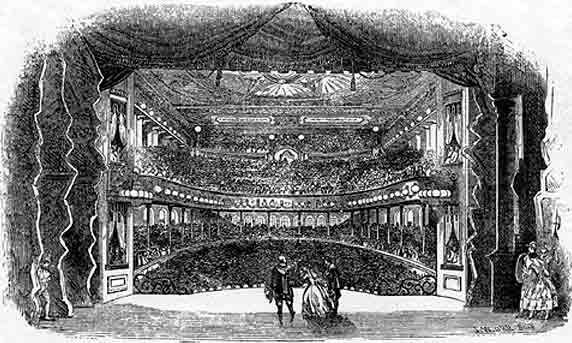 A
period print shows what Niblo's Garden looked like from the stage during a
performance of The Black Crook.
A
period print shows what Niblo's Garden looked like from the stage during a
performance of The Black Crook.
The Black Crook spawned a host of similar stage spectacles with fantasy themes, known as extravaganzas. None gave much care to plot or characterization, and the songs had little to do with stories that always involved whimsical trips to fairyland. But the best of these early musicals were clean and entertaining, so they became an established part of what was then referred to as "the show business."
The next musical form to rise on Broadway was full length burlesque. But these shows were nothing like the bump-and-grind girlie revues of the 20th Century.