
History of The Musical Stage
1910-1919: Part I
by John Kenrick
(Copyright 1996; revised 2020)
(The images below are thumbnails – click on them to see larger versions.)
Imported Hits
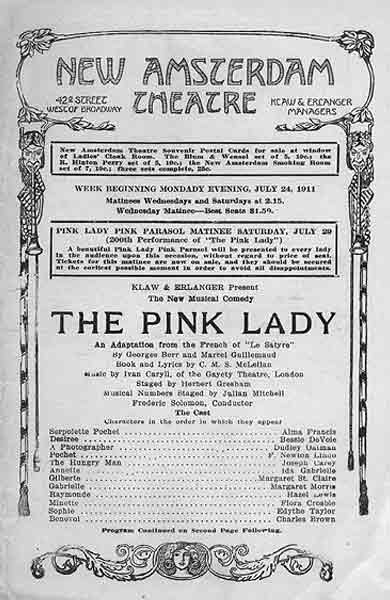 This
program title page for The Pink Lady (1911) announces
that complimentary pink parasols will be distributed to all ladies attending
the 200th performance.
This
program title page for The Pink Lady (1911) announces
that complimentary pink parasols will be distributed to all ladies attending
the 200th performance.
George M. Cohan and Victor Herbert were still turning out hits after 1910, but their scores were pretty much a continuation of the kind of work each had been doing since the start of the century.
From 1907 onwards, many Broadway producers inspired by The Merry Widow concentrated on importing musicals from Europe. Notable examples include –
Madame Sherry (1910 - 231 performances), a Viennese operetta involving a bachelor who pretends he is married in order to wheedle some money out of his wealthy uncle. The New York production kept the original plot, but American librettist Otto Harbach provided a new book and lyrics, with all-new melodies by Karl Hoschna. The waltz-laden score included the hit "Every Little Movement (Has a Meaning All Its Own)."
The Arcadians (1910 NY - 193 performances) was a British operetta that had residents of an earthly paradise trying to teach modern Londoners the value of honesty. It ran for more than two years on the West End. Despite a tuneful score by Lionel Monckton and Howard Talbot, it was only a moderate success in the US.
British composer Ivan Caryll's The Pink Lady (1911 - 320 performances) told the story of a young man stealing kisses in a French forest and some other loosely related romantic shenanigans. It made Hazel Dawn a star and initiated an American craze for "pink lady" drinks and fashions. With its popular "Kiss Waltz," The Pink Lady set a box office record for Broadway's massive New Amsterdam Theatre.
The Shubert Brothers had the 1874 Johann Strauss operetta Die Fledermaus translated into into a vehicle for vaudeville's popular Dolly Sisters, re-titled it The Merry Countess (1912 - 135 performances) and reaped healthy ticket sales.
Maid of the Mountains (1917) wowed World War I London with its old-fashioned tale of a country girl who loves a swashbuckling bandit, racking up a then-astounding 1,325 performances. It made a star of soprano Jose Collins, who would play the role for decades to come. A heavily revised 1918 Broadway version closed in less than a month.
World War I stifled the demand for German-language operettas in both America and Great Britain. Luckily, an American was ready to step into the void, opening a new era in American musical theatre.
Jerome Kern: "They Didn't Believe Me"
The American musical found a new creative direction thanks to Jerome Kern, a native New Yorker who got his start amending the scores of imported British musicals. Since British high society rarely arrived at a theatre on time, most London musicals of the early 1900s saved their best material for the second act and filled early scenes with forgettable fluff. These shows had to be revised for New York audiences, who tended to arrive for the first curtain and leave at intermission if the first act didn't hook them.
When producer Charles Frohman brought over the British hit The Girl From Utah (1914 - 120 performances), the plot (an American girl flees to London rather than become a rich Mormon's latest wife) proved amusing, but the British score was unremarkable. So Frohman hired Kern and veteran lyricist Herbert Reynolds to write five new numbers for the lackluster first act.
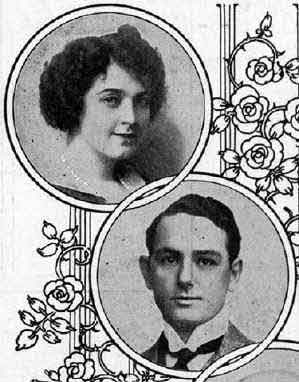 Julia Sanderson and
Donald Brian introduced Kern's "They Didn't Believe Me" in The Girl From
Utah.
These photos come from the original cast program.
Julia Sanderson and
Donald Brian introduced Kern's "They Didn't Believe Me" in The Girl From
Utah.
These photos come from the original cast program.
Kern and Reynolds had added songs to previous imports. This time they demanded and got full program credit. Their delightful ballad "They Didn't Believe Me" marked a turning point in the development of popular music. The melody defies time. Forthright sentiment meets refined romance, and the resulting sound has an ageless freshness that points to the Broadway musical's future. Rejecting the stilted, flowery poetry found in most period love songs, the lyric captured the easy cadence of everyday conversation –
And when I told them
How beautiful you are
They didn't believe me.
They didn't believe me.
Your lips, you eyes, your curly hair
Are in a class beyond compare
You're the loveliest girl
That one could see.
And when I tell them,
(And I certainly am going to tell them)
That I'm the man
Who's wife one day you'll be,
They'll never believe me,
They'll never believe me,
That from this great big world
You've chosen me.
- Transcribed from sheet music
As Julia Sanderson and Donald Brian sang those words in the Knickerbocker Theatre on the night of August 14, 1914, it is doubtful that they or their audience realized they were part of an historic moment. As far as they knew, it was just great entertainment. But "They Didn't Believe Me" eclipsed everything in the show's original British score and made Kern the hottest new composer on Broadway. Musical theatre -- in fact, all popular music -- would never be the same.
The Princess Theatre Musicals
Kern's made the most of his newfound popularity, composing sixteen Broadway scores between 1916 and 1920. The most memorable of these graced a series of innovative musicals for The Princess Theatre., a cozy 299 seat auditorium just south of Times Square on West 39th Street.
Producer Ray Comstock leased the Princess to present a dramatic repertory company, but that soon folded. Agent Elizabeth Marbury suggested that he produce small, low-budget musicals as alternatives to the lavish ones then dominant on Broadway. Comstock and Marbury joined forces, hired Kern and librettist Guy Bolton, limited production expenses to $7,500 (because of the small number of seats), and launched a series now referred to as The Princess Theatre Musicals.
Kern and Bolton began by adapting the London operetta Mr. Popple of Ippleton. They replaced the book and most of the score, reduced the chorus to a minimum, and renamed the show Nobody Home (1915 - 135 performances). The production barely broke even, but Comstock was encouraged enough to have Bolton & Kern attempt an original project.
The team focused on settings and characters that would be familiar to Broadway audiences of that time -- facing credible challenges. Very Good Eddie (1915 - 341 performances) involved two honeymooning couples who get involved in some innocent misunderstandings while cruising on a Hudson River steamboat. Because of the Princess Theatre's size, the production aimed for a naturalistic and seemingly informal style.
"With little or no space separating the players from the audience, Very Good Eddie depended upon the ease and credibility of the acting and characterization. Scarcely any previous musical comedy had been favored with a plot and dialogue so coherent, so nearly related to those of well-written non-musical plays."
- Cecil Smith, Musical Comedy in America (New York: Theatre Arts Books, 1950), p. 212.
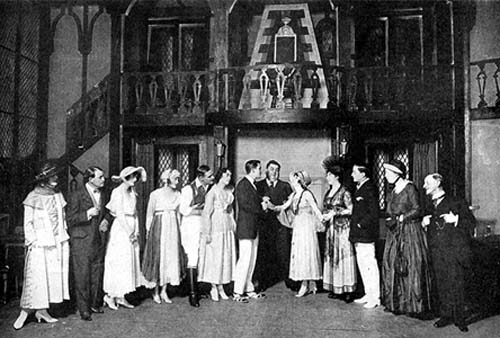 After
many misunderstandings, an innocent man and his suspicious wife are reunited
in the finale of Oh Boy! (1917),
the longest running Princess Theatre musical.
After
many misunderstandings, an innocent man and his suspicious wife are reunited
in the finale of Oh Boy! (1917),
the longest running Princess Theatre musical.
The Princess Musicals hit their full stride when British lyricist-librettist P.G. Wodehouse joined the team. The next few shows by Wodehouse, Bolton and Kern featured amusing plots, a trove of charming Kern melodies, and the wittiest lyrics since W.S. Gilbert –
Have a Heart (1917 - 76 performances) landed in the hands of producer Henry Savage, who greedily booked it into the sizeable Liberty Theatre. Perhaps that is why this story of a second honeymoon that nearly wrecks a marriage only lasted two months.
Oh Boy! (1917 - 463 performances) - While his wife is away, a well-intentioned newlywed lets a college girl avoid arrest by hiding out in his house. Then his wife comes home -- crisis! But all the tangled misunderstandings were resolved by the final curtain. With a score that included "Till the Clouds Roll By," this became the longest running Princess Theatre musical, one of the first American hits of its time to enjoy a successful run in London.
Leave It To Jane (1917 - 167 performances) - With Oh Boy! still enjoying a long run at the Princess, the team opened this show at the larger Longacre Theatre. A college president's daughter woos a rival school's star quarterback and loses her heart to him in the process. The catchy title tune and the comic "Cleopatterer" were highlights. A cozy 1959 revival Off-Broadway captured enough period charm to run for a whopping 928 performances.
Oh, Lady! Lady! (1918 - 219 performances) - A young man tries to convince an ex-girlfriend he was unworthy of her, and only succeeds in looking ridiculous to his new fianc'.
Oh, My Dear! (1918 - 189 performances) - A group of eccentric New Yorkers leave town to check into a health farm. With Kern otherwise occupied, the music was provided by Louis Hirsch. Despite a respectable run, everyone realized there was little point in continuing the series without Kern.
In a period interview, Bolton explained what he and his collaborators were trying to do:
"Our musical comedies . . . depend as much upon plot and the development of their characters for success as upon their music, and . . . they deal with subjects and peoples near to the audiences. In the development of our plot . . . we endeavor to make everything count. Every line, funny or serious, is supposedly to help the plot continue to hold."
- as quoted in Gerald Bordman's American Musical Theatre: A Chronicle (New York: Oxford Press, 1978), p. 330.
The Princess shows were not the first musicals to integrate song and story – Offenbach did that in the previous century, as did Gilbert and Sullivan. As for believable characters in everyday settings, Cohan and others started doing that over a decade earlier.
So what made the Princess series remarkable? Aside from an intimate performing style that presaged the future appeal of sound film, these were the first musicals to profit from the full creative genius of Jerome Kern. There is no question that Bolton and Wodehouse's wit was crucial to the success of the series, but it is Kern's music that captured the hearts of theatre goers. It is no accident that the series died after Kern left the team.
Kern loved it when his songs became hits, but he had a higher priority. As he once told an interviewer, "I'm trying to apply modern art to light music as Debussy and those men have done to more serious work." Kern would continue to enrich the musical stage and screen for decades to come, so there is more on him in the chapters ahead.
Just months after Kern made his contributions to The Girl From Utah, another great American composer unveiled his first complete stage score. Trained in the pop song traditions of Tin Pan Alley, Irving Berlin became an immediate Broadway legend.