
History of Musical Film
1930s Part II: Warner Brothers & Berkeley
by John Kenrick
(Copyright 1996; 2020)
(The images below are thumbnails – click on them to see larger versions.)
Forty-Second Street
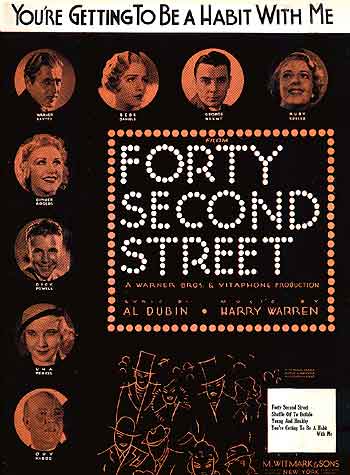 Warner Brothers' stellar cast
is featured on the original sheet music cover for "You're Getting to Be a
Habit With Me" from 42nd Street (1933).
This backstage saga rekindled America's interest in musical films.
Warner Brothers' stellar cast
is featured on the original sheet music cover for "You're Getting to Be a
Habit With Me" from 42nd Street (1933).
This backstage saga rekindled America's interest in musical films.
Due in large part to the immobility of early sound cameras, the first movie musicals could not make effective use of dance. So the industry was surprised when a series of dance-infused musicals from Warner Brothers Studios gave screen musicals a new lease on life. The studio itself was one of those hardest hit by the Great Depression. After earning a net profit of $17.2 million in 1929, Warners suffered a loss of $7.9 million in 1931, and was facing bankruptcy.
Busby Berkeley built a reputation as dance director for several Broadway shows and early sound films. But he reshaped his career and the future of musical cinema when he staged the dance sequences for the Warner Brothers backstage saga Forty-Second Street (1933). Packed with the kind of gritty urban atmosphere and hip, contemporary dialogue that was a hallmark of most Warner Bros. films in the 1930s, this surprise hit established several show business musical plot clichés:
- The hard-nosed Broadway director literally dying for a new hit.
- The egotistical star who breaks an ankle, making way for . . .
- The unknown but talented chorus kid who takes over the star's role on opening night and (what else?) triumphs.
The score had just four songs by composer Harry Warren and lyricist Al Dubin. You're Getting to Be a Habit With Me," "Young and Healthy," "Shuffle Off to Buffalo" and the catchy title tune all became hits. Delighted audiences packed theatres nationwide, and 42nd Street, produced for approximately $400,000, earned $2.3 million in its initial release.
Although 42nd Street was directed by screen veteran Lloyd Bacon, Warner Brothers realized that it was Berkeley's new approach to camera work and choreography that had set the film apart. The studio immediately put Berkeley to work helming a series of lavish musicals combining backstage show biz romances with spectacular dance ensemble too large for any Broadway theater.
Berkeley was the first to take full advantage of synchronizing a filmed image to a previously recorded musical soundtrack. Since microphones were not needed during the filming of musical sequences, Berkeley realized that cameras no longer had to be imprisoned in sound-proof booths during production numbers. For the first time since the introduction of synchronized sound, fluid camera motion and intricate editing were once more achieveable. Berkeley revolutionized screen musicals by exploiting these possibilities.
The Berkley Style
Berkeley was the first director to clearly understand that effective screen choreography involved the placement and movement of the camera as well as the dancers. Instead of only filming numbers from fixed viewpoints, he set his cameras into motion on custom built booms and monorails.
The normally frugal Warner Brothers allowed Berkeley to film his fantasy numbers on a grand scale. Sweeping views of geometrically arranged dancers moving in unison became a Berkeley trademark, including kaleidoscopic patterns of uniformly costumed chorus girls. He would literally cut through the roof of a soundstage to get the right distance for an overhead shot. He also relied on elaborate sets and such bizarre touches as a leering midget trying to glimpse chorus girls while they disrobed behind a translucent curtain.
Sometimes erotic, sometimes vulgar, the best of Berkeley's images delighted a nation desperate for cinematic distraction from the Great Depression, and all of his 1930s Warner Brothers films were filmed in glorious black and white.
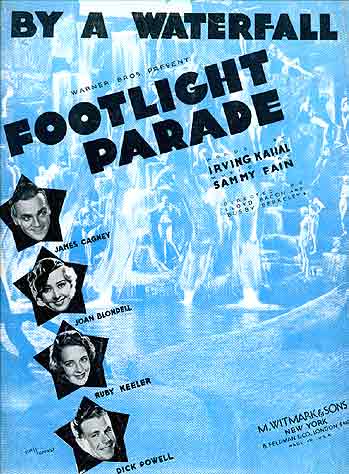 The original
sheet music cover to "By a Waterfall" from Footlight Parade (1933)
features the film's stars but uses
Busby Berkley's splashy staging of that number as background
art.
The original
sheet music cover to "By a Waterfall" from Footlight Parade (1933)
features the film's stars but uses
Busby Berkley's splashy staging of that number as background
art.
Several of Berkeley's films starred Ruby Keeler and Dick Powell. Wholesome and likeable rather than glamorous, they were the perfect "boy/girl next door" combination, and while Keeler's dancing was more game than masterful, Powell had one of the most attractive tenor voices in musical film. The Berkeley-Warner films also featured wonderful songs by Harry Warren, Al Dubin, Richard Whiting, and Johnny Mercer. The best of these songs were almost always showpieces that did nothing to develop character or advance plot.
In several cases, Berkeley saved the majority of production numbers for the final part of the film, providing a sort of montage. The goal was not to create an integrated musical, but to offer generous doses of tuneful, larger-than-life fantasy. (It is also possible that, fearing another chance in public taste, the studio wanted to make it easier to delete the musical sequences without disrupting the rest of the film.)
The Gold Diggers of 1933 - "We're In the Money"
Footlight Parade (1933) - "By a Waterfall," "Honeymoon Hotel"
The Gold Diggers of 1935 - "Lullaby of Broadway"
Hollywood Hotel (1937) - "Hooray for Hollywood"
42nd Street was produced for a relatively modest $439,000, so it had no problem earning a profit. When Berkeley allowed Footlight Parade's cost to balloon to $700,000, Warner Brothers reigned in the expenditures for Busby's future projects.
Although Berkeley's musical sequences remained visually inventive, his formulaic backstage plots grew predictable. Emotional difficulties and drunk driving charges further compromised his professional standing. When the popularity of the Berkeley musicals faded in the late 1930s, he left Warner Brothers and spent the next two decades at MGM.
"But a uniquely American style had been set in the film musical, one that owed little to the Broadway model. "Lullaby of Broadway" for instance, is pure film and pure Hollywood: visually, in its real-life montage; physically, in its cavernous nightclub; musically, in its seedy populist jive; and ideologically, in its horrified fascination with New York nightlife."
- Ethan Mordden, The Hollywood Musical (New York: St. Martin's Press, 1981), p. 88.
After the Waterfall
Busby Berkeley's later work at MGM would prove commercially successful, most notably a series of hits co-starring Mickey Rooney and Judy Garland (more on them in the pages ahead). But in the producer-centered MGM system, directors lacked the creative independence and high profile Berkeley had once enjoyed at Warner Brothers. Although still capable of creating memorable ensemble moments, Berkeley's emotional instability and verbally abusive on-set treatment of Garland and other performers eroded his reputation. He continued working as a screen choreographer, but was considered a minor figure by the 1950s.
Berkeley and his Warner Brothers musicals were rediscovered by scholars and film buffs. He became a popular presence at universities and on TV talk shows, and served as "production supervisor" for the smash hit 1971 Broadway revival of No, No Nanette starring Ruby Keeler. Whatever Berkeley's personal demons, his 1930s screen musicals remain cultural landmarks, cementing his place in cinematic history.
The Production Code
When a series of off-screen scandals inspired an anti-Hollywood backlash in the early 1920s, the major studios joined forces and hired Republican politician Will Hays to head the new Motion Picture Producers and Distributors of America (MPPDA), an organization that aimed to restore the industry's reputation by censoring film content. Hays, an alumni of President Harding's scandal-ridden administration, announceded a number of superficial changes in the film industry, then settled into the background. When the advent of sound film -- and a fresh series of off-screen Hollywood murders and sex-scandals -- brought another public outcry, Hays instituted the 1930 Production Code.
Along with forbidding nudity and profanity, this code included a long list of rules that now seem laughable. A few examples --
- Screen kisses had to be close-mouthed and were limited to six seconds.
- Whenever two characters embraced, at least one of them had to keep at least one foot on the floor.
- No plot could present evil "alluringly."
- Even if married, a man and woman could not be shown sharing the same bed.
- Seduction could not be the subject of comedy.
- No religious minister could be a comic or villainous character.
- Such words as "broad," "pregnant," "Lord" and "hold your hat" were prohibited.
- In fact, any line, costume, character or situation censors deemed "unnecessary" or "objectionable" could be forbidden.
For several years, film makers resisted or openly flaunted the code. Then the Roman Catholic Church formed a nationwide Legion of Decency to enforce studio compliance. Spurred on by this, Hays appointed Joseph I. Breen to stringently administer the production code. A devout Catholic, blatant anti-Semite (he openly referred to Jews as "the scum of the earth") and homophobe, Breen set out to "clean up" the content of Hollywood films with unflinching zeal. By 1934, all American films were forced to conform to the code..
The new Production Code Administration took part in the writing, filming and editing of every Hollywood project from 1934 though the mid-1960s, so the code had a major impact on America's screen musicals. Sex and adultery were eliminated as comic subjects. Aside from flesh becoming less visible, the sort of witty naughtiness championed by director Ernst Lubitsch in earlier films was banished. Under the code, new films by once-bold performers like Mae West were simply not the same. In effect, the American film industry was sexually neutered.
The studios had to find creative ways to bring some hint of sex to the screen in subtle, code-friendly forms. For example, RKO discovered a duo that made the whole world want to dance "cheek to cheek."