
History of The Musical Stage
1970s: Part IV - Book Musicals
by John Kenrick
(Copyright 1996; revised 2014)
(The images below are thumbnails – click on them to see larger versions.)
New Rhythms
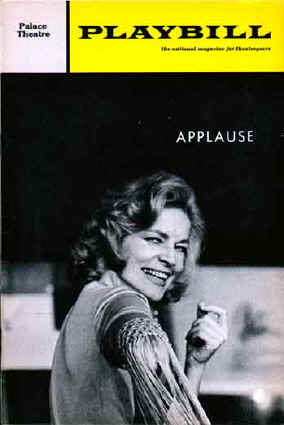 Lauren Bacall starred in Applause (1970), the
first major musical hit of the decade.
Lauren Bacall starred in Applause (1970), the
first major musical hit of the decade.
The book musical had been a Broadway's staple since Oklahoma, and the format managed an impressive comeback in the 1970s. Several writers took the common sense approach of adding contemporary musical flavoring to otherwise conventional musicals.
Charles Strouse and Lee Adams, who used early rock and roll effectively in Bye Bye Birdie, had similar success with Applause (1970 - 900 performances), which re-set the back-stabbing plot of the film All About Eve in the theatrical world of 1970. This time, rock rhythms and orchestrations gave a "mod" sound to traditional showtunes, and the presence of 1940s movie star Lauren Bacall cemented the show's success with mainstream theatergoers. She couldn't sing worth a damn, but her star power sold plenty of tickets. Tonys went to Bacall, director-choreographer Ron Field, and the show itself as Best Musical.
Two black dramas were adapted into popular book musicals, both with mostly white creative teams and scores packed with contemporary pop style.
- Purlie (1970 - 690 performances) was
based on Ossie Davis' 1961 comedy Purlie Victorious, the story of a black preacher
fighting bigotry and finding love in the segregated South. Cleavon Little was irresistible
in the title role, and Melba Moore won raves as his beloved with some
death-defying vocal pyrotechnics – both performers received Tony Awards.
- Raisin (1973 - 847 performances) was a scrupulously faithful musical adaptation of Lorraine Hansberry's hit 1959 drama Raisin in the Sun. The score proved less than memorable, but the story of an inner city black family trying to balance ambition with integrity retained its power. The show copped the Tony for Best Musical, with a Best Actress award for the show's indomitable matriarch, Virginia Capers.
Despite decent runs, both Purlie and Raisin wound up losing money. At the other extreme, Ain't Misbehavin' (1978 - 1,604 performances) revitalized the revue format with an all-black cast in beguiling vignettes built around songs either written or performed by jazz legend Fats Waller. Created by lyricist/director Richard Maltby, it brought stardom to rotund comedienne Nell Carter. She and Maltby won Tonys, and the show received the the award for Best Musical. The long, profitable run put the production's nonprofit birthplace, the Manhattan Theatre Club, in the commercial spotlight
Nostalgic Misfires
New musicals written in period style such as the Andrews Sisters vehicle Over Here (1974 - 341 performances) had appeal, but most of the new book musicals in the mid-1970s met with disaster. Some fizzled despite good scores and distinguished casts.
- Cyrano (1974 - 49 previews, 5 performances performances)
starred Christopher Plummer, who received the Tony for
Best Actor in a Musical. But this strong adaptation of Rostand's
classic play felt like operetta and did not find an audience.
- Molly (1974 - 68 previews, 40 performances performances) was
based on Molly Goldberg's radio and TV sitcom about Jewish-American family life.
It marked comedienne Kay Ballard's last starring role in a new musical.
- Mack and
Mabel (1974 - 69 performances) featured one of
Jerry Herman's
finest scores and a cast headed by Robert
Preston and Bernadette
Peters. But the tragic true life love story of silent screen
director Mack Sennett and actress Mabel Normand made
the libretto unworkable.
- Shenandoah (1975 -
1,050 performances) was based on a classic film about a Virginia farmer and his family
facing the nightmare of the American Civil War. A handsome
TV campaign, the catchy tune "Freedom," a stellar performance
by John Cullum, and steep
ticket discounts kept the show running for several years, but the
production never repaid its original investment.
- Rex
(1976 - 48 previews, 14 performances) had a rich score by
Richard Rodgers
and lyricist Sheldon Harnick,
but England's murderous King Henry VIII proved too hateful to be the protagonist
of a musical. Leading man Nicol Williamson's rude misbehavior both on and off stage
(he once slapped a chorus member in full view of the audience) kept the
gossip columnists busy for the entire nine week run.
Palpable Hits
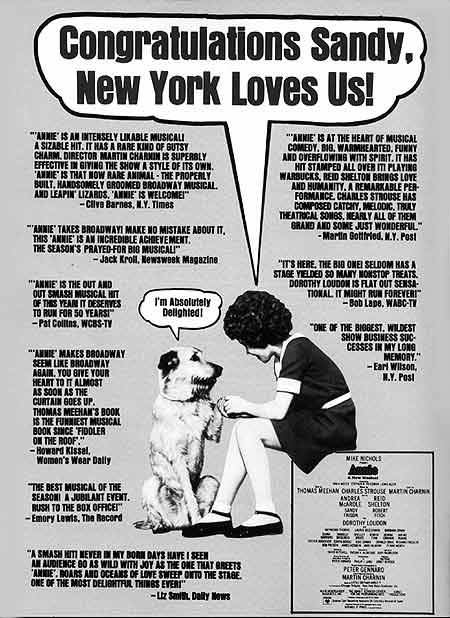 When
Annie (1976) opened to extraordinary critical acclaim, the producers
celebrated with this full page ad in the NY Times. (This is a large image –
if clicked, it may take some time to download.)
When
Annie (1976) opened to extraordinary critical acclaim, the producers
celebrated with this full page ad in the NY Times. (This is a large image –
if clicked, it may take some time to download.)
Some suggested that the standard book musical was an endangered Broadway species. Then an orphan girl and a scruffy dog re-energized the genre. Both critics and audiences melted for Annie (1976 - 2,377 performances), a shamelessly old-fashioned musical inspired by the comic strip Little Orphan Annie. It told how a penniless tyke met and captured the heart of billionaire Daddy Warbucks, finding love, adventure and a loveable mutt named Sandy along the way. Newcomer Andrea McArdle gave a disarming performance as the title orphan in search of "Tomorrow," and Dorothy Loudon copped the Tony with a hilarious performance as Miss Hannigan, the harried orphanage director who has come to loathe "Little Girls" and wants to enjoy life on "Easy Street."
Composer Charles Strouse, lyricist Martin Charnin and librettist Thomas Meehan made Annie's success seem deceptively simple, but it was so skillfully written and produced that few could follow in its creative footsteps. This multiple Tony winner became an international sensation, proving that the traditional musical could still win audiences. Annie was the first Broadway musical to gross over $100 million, astounding for a show which opened with orchestra seats at a mere $16. (Note: By the time it closed six years later, the same seats went for $45.)
Towards the end of the decade, two more variations on the traditional book musical topped the 1,000 performance mark.
- The Best Little Whorehouse in Texas (1978 - 1,703 performances)
was inspired by the real-life political shenanigans that forced the
closing of an infamous bordello. It became lasting hit thanks to
Tommy Tune's energetic staging,
a bawdy libretto, and some catchy country-style tunes
by Carol Hall. TV ads for the show had to bleep out the
word "whore" in the title to meet federal broadcast
standards -- but as a lyric put it, there was "nuthin' dirty
goin' on," and audiences embraced the show.
- Neil Simon's hilarious book for
They're Playing Our Song (1979 - 1,082 performances) offered a
conventional musical comedy romance between a composer and lyricist,
played with disarming brio by Robert Klein and Lucie Arnaz.
The Marvin Hamlisch-
Carol Bayer Sager score infused some
witty showtunes with the rhythms of late-70s pop.
As the decade ended, change was in the air, including the vanguard of a European invasion that would dominate Broadway into the end of the century.