
History of The Musical Stage
1990s: Rent and A Century's End
by John Kenrick
(Copyright 1996; revised 2014)
(The images below are thumbnails – click on them to see larger versions.)
When the Pulitzer Was Up For Rent
 The original
Off-Broadway program cover for Rent.
The original
Off-Broadway program cover for Rent.
By the late 1990’s, almost every show that made it to Broadway was a corporate product. With the average musical budget running over $8,000,000, it took a lot of people to finance a show, and they all wanted some say in the production. This left no room for amateurs, rebels or artists.
Even the much ballyhooed Rent (1996 - 5,123 performances) was nurtured for a year by a company that booked and produced national tours. I was an assistant in their office during the two years leading up to Rent's off-Broadway premiere. Rent's producers had vision and took a genuine risk, but it was a calculated risk informed by years of business experience. They guided composer-lyricist Jonathan Larson through extensive rewriting in the months before the show opened at The New York Theatre Workshop, and would probably have encouraged further revisions had Larson lived.
As it was, the composer's unexpected death on the night of the Off-Broadway dress rehearsal made Rent a cultural cause celebre. As the show moved to Broadway on a wave of sympathetic publicity, no opportunity was wasted. Long before arranging foreign production rights, the producers were authorizing a Rent fashion department at Bloomingdales. For all the fuss made over Rent's contemporary rock score, nothing from the show ever made it to the pop charts. It was an outright failure in London, where critics and audiences were less susceptible to the poignancy of the composer's death.
As with corporate musicals, the independently produced Rent was reproduced world wide with the precision of photocopies. The simple set, bargain-basement costuming and rudimentary staging could be easily re-created or packaged for travel. From New York to Tokyo, blonde-dyed male leads wrapped their bare biceps around curly-haired Mimis as their head mikes met in an identical kiss. Staged at one-fourth the cost of The Lion King but charging the same ticket price, hefty profit was assured. Critic Ron Lasko commented –
"I have nightmares every time I see the new ad campaign for Rent that features an entirely new cast of actors that look and act exactly like the original cast; its like some B-Horror movie version of itself, 'Invasion of the Rent People.' "
- Next magazine 10/29/99
"Fortune's Winds Sing Godspeed"
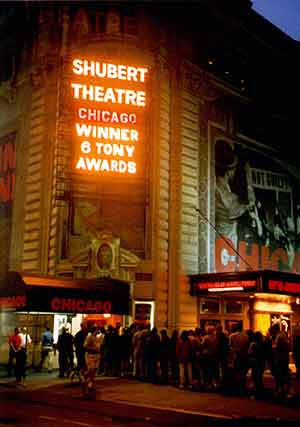 The
1996 concert staging of Chicago became the longest running revival
in Broadway history.
The
1996 concert staging of Chicago became the longest running revival
in Broadway history.
Two well-known Kander and Ebb musicals returned to Broadway in the mid-1990s in revivals that gave them as much impact as new hits. A five performance City Center Encores! concert version of Chicago (1996 - 7,300+ performances, still running) was such a sensation that it moved to the Shubert Theatre. Co-directors Walter Bobbie and Ann Reinking paid tribute to the late Bob Fosse's original intentions, but gave the show a simple, streamlined staging that made this cynical look at fame and American pop culture seem even more timely than it was in 1975. The Roundabout Theatre brought over a hard-edged British production of the 1967 hit Cabaret (1998 - 2,306 performances) that rankled traditionalists but delighted many others. Thanks to rave reviews and a succession of stellar replacement casts, both revivals outran their original productions.
The most successful black musical of the decade was Bring in Da' Noise, Bring in Da' Funk (1996 - 1,148 performances), which used a series of contemporary tap numbers to look dramatize and reflect on the history of Africans in America. The score was new, but the key issue was the dancing, which expressed every emotion from despair to rage to triumph. Savion Glover headed a spitfire cast and received a Tony for his groundbreaking choreography.
One of the few new American composers to find an audience on Broadway in the 1990s was Frank Wildhorn. His turgid adaptation of Jekyll & Hyde (1997- 1,543 performances) developed a dedicated cult following, and his entertaining The Scarlet Pimpernel (1997 -772 performances) was revised twice during its run. Wildhorn made a noisy misstep with The Civil War (1999 - 61 performances), an incoherent attempt to present America's national nightmare in a semi-revue format. But although none of these shows proved profitable, there was no question that his works appealed to a dedicated, if limited, audience.
The best musicals of the late 1990s came from corporate producers that aimed for artistic integrity as well as profit. Composer/lyricist Maury Yeston (Nine, Grand Hotel) and librettist Peter Stone (1776), had built their reputations on making unlikely projects sing. When their Titanic (1997 - 804 performances) sailed off with five Tonys, including Best Musical, the theatrical community was shocked. The best new American musical in over a decade, it put creative aspects ahead of the marketing concerns. Over a dozen key characters were defined through songs which invoked various period or ethnic styles: the hopeful immigrants dreaming of life "In America," the arrogance of the rich exclaiming "What a Remarkable Age This Is," and the elderly Isador & Ida Strauss reaffirming that they "Still" love each other as they face death. A stronger director or solo producer might have sharpened the dramatic focus, but corporate thinking let matters lie. Whatever its imperfections, Titanic deserved its success.
 Ragtime
(1998 - 861 performances) was another example of the corporate musical at its best, thanks to
a spectacular score by American composers Lynn Ahrens and Stephen Flaherty.
The epic story told of a crumbling white middle class family, a black musician seeking justice, and a Jewish immigrant
fulfilling the American dream for himself an his child. As with Titanic, a huge
cast of characters was brought into focus by a score that invoked musical styles from the
early 20th century and a book that wove disparate lives into a common pattern
– the concept musical blown up to epic proportions. Ragtime was not
afraid to use satire ("Crime of the Century") or raunchy humor ("What A
Game") along with soaring chorales, ballads and rags. When
Brian Stokes Mitchell (as musician Coalhouse Walker)
and Audra McDonald (as his beloved Sarah) sang of
how they would ride into the future "On the Wheels of a Dream," it was pure, potent
musical theatre. Though overproduced and under-directed, Ragtime was a musical with
brains, heart, and a touch of courage.
Ragtime
(1998 - 861 performances) was another example of the corporate musical at its best, thanks to
a spectacular score by American composers Lynn Ahrens and Stephen Flaherty.
The epic story told of a crumbling white middle class family, a black musician seeking justice, and a Jewish immigrant
fulfilling the American dream for himself an his child. As with Titanic, a huge
cast of characters was brought into focus by a score that invoked musical styles from the
early 20th century and a book that wove disparate lives into a common pattern
– the concept musical blown up to epic proportions. Ragtime was not
afraid to use satire ("Crime of the Century") or raunchy humor ("What A
Game") along with soaring chorales, ballads and rags. When
Brian Stokes Mitchell (as musician Coalhouse Walker)
and Audra McDonald (as his beloved Sarah) sang of
how they would ride into the future "On the Wheels of a Dream," it was pure, potent
musical theatre. Though overproduced and under-directed, Ragtime was a musical with
brains, heart, and a touch of courage.
Century's End: Old and New
The 1998-99 season was one of disappointments. The few new musicals suffered from serious flaws.
- A stage adaptation of the film Footloose
(1998 - 737 performances) had enthusiasm but reeked of professional ineptitude - a
fact that repulsed critics but drew strong ticket sales.
- A bloodless stage adaptation of Saturday Night Fever
(1999 - 500 performances) was dismissed by the critics, but still racked up a fourteen
million dollar advance – proving yet again that there is no underestimating
the taste of some ticket buyers.
- Despite composer John Michael LaChiusa's insistence that his
Marie Christine (1999 - 44 performances) was a musical, it was a
didactic modern opera inaccessible to most audiences.
- Parade (1998 - 84 performances) was a somber history
lesson with little audience appeal, given a handsome production by
director Hal Prince. The true
story of a bigoted Southern mob lynching a Jewish man for a crime he
didn't commit, this show had few admirers until after it closed. As
the only major book musical competing with Footloose, Parade
copped Tonys for Best Book and Score.
- A revised Annie Get Your Gun
(1999 - 1,046 performances) gave the radiant
Bernadette Peters her strongest vehicle
to date, and her second Tony as Best Actress in a Musical. Despite
clumsy cuts, Irving Berlin's finest stage score still delighted
audiences.
- Fosse (1999 - 1,108 performances),
a compendium of the late choreographer's finest dances, was the season's
longest running hit. Consisting of previously seen material, it
could hardly be called a new show, but it won the Best Musical Tony.
Co-directed by Richard Maltby Jr. and
Ann Reinking, with special assistance by
Fosse's widow Gwen Verdon, it offered a wide
ranging look at what this "razzle dazzle" genius had accomplished.
An acclaimed revival of Kiss Me Kate (1999 - 885 performances), stood out all the more in an era when most new musicals were marked by intellectual vapidity and a terminal shortage of humor. Audiences were amazed to hear themselves laugh out loud at lyrics for the first time in years – proving Cole Porter's genius was indeed timeless. After years of "heavy" musicals, theatre goers were hungry for something happier. But musical comedy was dead and buried -- wasn't it?
After flourishing through most of the 20th Century, the Broadway musical was in uncertain condition at century's end. Shows that appealed to the lowest common cultural denominator thrived, while wit and melody were reserved for revivals. Musical theater professionals and aficionados had good reason to wonder what the next century might bring.