
Flops on CD: A to C
Reviews by John Kenrick
(Copyright 2000, Revised 2002)
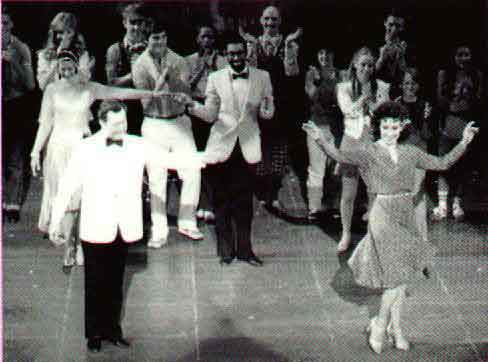 Donald
O'Connor & Chita Rivera in Bring Back Birdie. Click on this thumbnail
image to see a larger version.
Donald
O'Connor & Chita Rivera in Bring Back Birdie. Click on this thumbnail
image to see a larger version.
Click on the links below to reach a specific review.
- Anastasia/Anastasia Affaire
- Annie Warbucks
- Baker's Wife
- Ben Franklin in Paris
- Best Little W-house Goes Public
- Biograph Girl
- Birds of Paradise
- Blues in the Night
- Bring Back Birdie
- Canterbury Tales
- Carmelina
Anastasia - OC Records
(originally released as Anastasia Affaire - Bay Cities)
This musical version of the play Ingrid Bergman filmed in 1956 was called
Anya on Broadway in 1965, but a fine cast that included Constance Towers
and Lillian Gish could not overcome poor reviews. Robert Wright and George Forrest,
who adapted classical melodies so successfully in Kismet and
Song of Norway, never gave up on this Rachmaninoff-based score. They revised
it several times under different titles, finally re-recording it as Anastasia
Affaire for the Bay Cities Label. It has since been re-released
by OC Records with several additional tracks.
Eloquent and melodic, this score gets an intimate (piano only) but effective treatment on this CD. A dazzling cast is headed by three Tony winners. Judy Kaye, one of the finest performers the American musical theatre has ever known, dazzles in the title role. Opera diva Regina Resnik gives a moving performance as the Dowager Empress, and Len Cariou is perfect as General Bounine, the bold schemer out to capture the Romanov fortune. Broadway stalwarts Steve Barton, George Lee Andrews and Walter Willison are in the supporting ensemble.
Highlights include Anna's triumphant aria "I Live Again" and her endearing duet with the Empress, "Think Upon Something Beautiful." You won't want to miss Resnik's work in the finale. I don't know how this material would work on stage, but it is a treat to hear a first-class cast of singing actors make the most of such a demanding score.
Annie Warbucks - Angel
This sequel went through several incarnations before opening off-Broadway in 1993, with three synthesizers in the pit -- a sonic disappointment! Happily, this recording offers the same cast with full orchestra, showing the score off to much better advantage. As Warbucks, Harve Presnell soars through the ravishing "A Younger Man." Donna McKechnie shines in "But You Go On", Marguerite MacIntyre sings Grace Farrell's "It Would Have Been Wonderful" to perfection, and Annie's original FDR Raymond Thorne handily steals "All Dolled Up." Little Kathryn Zaremba was a gutsy and loveable Annie, and the other orphans were well cast. Alene Robertson has the thankless task of playing Commissioner Doyle, a role patterned a bit too closely after Miss Hannigan.
Ensemble highlights include "That's The Kind of Woman" and the under-utilized "When You Smile." If you love Annie, you will probably enjoy this recording too. Although this show has its weaknesses, theatre groups should consider producing it for family audiences.
The Baker's Wife - Take Home Tunes/OC Records
When The Baker's Wife closed on the road in 1976, this independently produced recording made history by turning a flop stage musical into a cult favorite on both sides of the Atlantic. The four lead actors preserved eleven numbers in enthusiastic performances. However problematic the show may be onstage, it is a charmer on this CD.
Paul Sorvino (who took over the lead from Topol, who's behavior alienated most of the cast and creative team) plays a middle aged baker who's wife leaves him for a young rake. His superb singing may take some fans by surprise, but he is brilliant in "Merci, Madam," "Any-Day-Now-Day," and the powerful lament "If I Have to Live Alone." Patti Lupone's powerful rendition of "Meadowlark" became a cult event in itself, and Kurt Peterson is wickedly funny in "Proud Lady." I know many who think Teri Ralston's "Chanson" is a jewel. No serious showtune collection is complete without this recording. The pricey double CD of the London Cast has more material but is not nearly as satisfying.
Ben Franklin in Paris - Angel
Unable to compete with the success of Fiddler, Hello Dolly! and Funny Girl, this genial show had a relatively brief life. It deserved a better fate. The melodic score by composer Mark Sandrich Jr. and lyricist Sidney Michaels (plus two fine Jerry Herman songs interpolated during tryouts) is beautifully preserved here. It may not rate as a masterpiece, but offers lots of fun moments.
Robert Preston drips charm as Franklin, using diplomacy and romance to advance the cause of American liberty at the royal court of France. His numbers include the Harold Hill-ish "I Invented Myself" and Jerry Herman's lovely interpolated ballad "To Be Alone With You." Preston even has fun with the lesser numbers, including the silly drinking song "God Bless the Human Elbow." His monologue in the final track is a highlight.
Swedish stage star Ulla Sallert is delightful as the influential countess Franklin pursues, at her best in "How Laughable It Is" and Herman's other interpolation, "Too Charming." The ever reliable Susan Watson has several minor but endearing numbers as a Parisian girl who romances Franklin's stuffy grandson. The supporting cast is fine throughout. The CD release made this once hard-to-find recording readily accessible. Well worth having, especially for Preston fans.
The Biograph Girl - TER
This little-known British musical covers the rise and fall of silent movies as experienced by Lillian Gish, D.W.Griffith and Mary Pickford – who was once anonymously billed as "The Biograph Girl." Presented by London impresario Harold Fielding back in 1980, it had a brief run and has not received a major American staging.
What a delightful score! From the opening silent movie-style piano riffs, composer David Heneker (Half a Sixpence) offers a parade of catchy tunes in various 1912-1930 period styles. (The disco-style arrangement for "Diggin' Gold Dust" is a glaring misfit, but passes quickly.) Sheila White gets the lion's share of showstoppers as Pickford, including "Working In Flickers," "I Want to Be the Way I Am" and the first-rate title tune. The Gish and Griffith characters have less interesting material, but their ballads are good. The chorus gets the jaunty Charleston showstopper "Nineteen Twenty Five."
Though not on a par with Mack and Mabel (by the by, Mack Sennett shows up here too), The Biograph Girl makes for highly enjoyable listening and would certainly be worth investigating for community or college productions.
The Best Little Whorehouse Goes Public - Varese Sarabande
Although nothing in the entertaining hit The Best Little Whorehouse in Texas suggested any need for a sequel, Tommy Tune and some of the show's creative team made the ill-advised decision to do this follow-up. The plot: Miss Mona takes over a bankrupt Las Vegas brothel, and when her romantically inclined business manager starts selling stock in the place on Wall Street, righteous politicians go ballistic.
This hopelessly tacky clunker closed in days. Leads Dee Hoty, Scott Holmes, Ronn Caroll do their damnedest. They and an energetic supporting cast all deserved much better material. "I'm Leavin Texas" is breezy and guaranteed to piss off jingoistic Lone Star natives. Otherwise, the Carol Hall score ranges from forgettable to just plain lousy. "Let the Devil Take Us" rates as one of the most confusing, irrelevant opening numbers in Broadway history. Theatre companies are advised to avoid this show – especially if they are located anywhere in or near Texas.
Birds of Paradise - TER
Directed by Arthur Laurents, this Off-Broadway production got lots of attention when it opened at the Promenade Theatre in 1987. I saw and enjoyed it, but the critics broke out their long knives. The plot: when a popular actor's career stalls, he returns to direct his hometown's community theatre production of a musical version of Chekhov's The Seagull. The star-worshipping locals include the actor's onetime sweetheart and her teenage son – who is author of the bizarre musical. After several romantic twists, the actor-director abruptly leaves to take on a role in New York. The disillusioned locals carry on with a new appreciation for their own self worth.
Composer David Evans and lyricist Winnie Holzman provided a polished score, and the solid cast of Broadway musical favorites couldn't be better. Todd Graff, Donna Murphy, Christa Moore, John Cunningham, Andrew Hill Newman, J.K. Simmons and Barbara Walsh are all in top form, and Mary Beth Peil devastates with "You're Mine" – a killer ballad that left the audience roaring the night I attended. The opening "So Many Nights" does a great job of setting the scene, and "Penguins Must Sing," from the show within the show, is a hoot. Birds of Paradise is a natural for community theatre productions, and the outstanding cast makes this recording a must-have for serious collectors.
Blues in the Night - First Night Records
After failing on Broadway, Blues in the Night went on to modest success in London and eventually returned to New York for a brief Off-Broadway run. It uses eighteen classic blues and jazz numbers to reflect on the experiences of three women and one man.
The London cast recording has socko performances by Debby Bishop, Maria Friedman and Clarke Peters. Carol Woods is a standout as the "Woman of the World," scoring points with every number. The score consists of many familiar and lesser-known blues tunes. Any small theatre group that can boast four solid African American singers would do well give this show a try, and collectors will certainly enjoy this CD.
Bring Back Birdie - Varese Sarabande
There has never been a successful Broadway musical sequel, but that didn't stop Charles Strouse and Lee Adams from attempting a follow-up to Bye Bye Birdie. Twenty years after the original story, Albert Peterson (to his wife Rose's consternation) gives up his career as an English teacher to find the long-lost Conrad Birdie for an appearance at the Grammy Awards. They find Birdie has changed his name and is the overweight sheriff of a small Arizona town – where Albert's long-lost mother is an innkeeper. Albert & Rose must simultaneously deal with their rebellious teenage children and find a way to keep their marriage together.
The show was unwieldy and poorly staged, but the score offers plenty of campy fun. Chita Rivera (revisiting her Bye Bye Birdie role as Rose) offers showstopping renditions of "I Like What I Do" and "A Man Worth Fightin' For." As Albert, Donald O'Connor sings the humorous "Middle Age Blues" and has fun throughout. When I caught the show, the closing rendition of "Rosie," had the crowd roaring its approval – indicating how much better off the composers might have been if they had simply revived the much-loved original.
Maria Karnilova, as Albert's hateful mother, makes the most of "I Love 'Em All," and Elvis-impersonator Marcel Forestieri tears the place apart singing Conrad's "You Can Never Go Back." This recording is a must-have for fans of the original Birdie, but I would warn theatre groups to think twice before trying to produce the disjointed book.
Canterbury Tales - Angel
When Chaucerian scholar Nevill Coghill teamed with pop composers Richard Hill and John Hawkins to create a musical version of the Canterbury Tales, the British public took it to their hearts and kept it running for over 2,000 performances. Despite a magnificent cast, the Broadway production lasted four months.
You'll find no madrigals here. The score is pure 1960s British rock-pop, a sound which has not aged well. Most of the selections are less than two minutes in length, sounding more like snippets than complete songs. Consequently, the cast gets few opportunities to shine on this recording. D'Oyly Carte veteran Martyn Green plays the narrator, and his troupe of pilgrims includes George Rose, Ed Evanko, Sandy Duncan and Reid Shelton. As the Wife of Bath, Hermoine Baddley sings the boisterous "Come On and Marry Me Honey."
I saw the charming but unsuccessful 1978 Broadway revival, and can testify that this musical is very entertaining on stage – a great choice for college groups. However, as a listening experience, I think Canterbury Tales leaves a lot to be desired.
Carmelina - Original Cast Records
This show closed after a brief Broadway run, the victim of unanimously poor reviews. Most of the original cast reunited sometime later for this cult-favorite recording, with the exception of opera star Cesare Siepe, who was ably replaced by Paul Sorvino – who displays a stunning opera-quality tenor voice here. Georgia Brown is wonderful as Signora Campbell, an Italian woman who was romanced by three American soldiers during World War II. Unsure which one fathered her child, she collects support from all three and raised her daughter in style. When a reunion brings the veterans back to Italy, Carmelina must confront her past while trying to build a new life with the local man (Sorvino) she now loves.
The Burton Lane-Alan Jay Lerner score has moments of genuine magnificence. The romantic "It's Time for a Lovesong" is pure magic, as is "Love Before Breakfast." The sentimental trio "One More Walk Around the Garden" is gorgeous, and "Someone in April" is one of the most ingenious plot exposition numbers ever written. Brown has a blast with the understated "Why Him?" and the sizzling "I'm a Woman." Sorvino gets to work with playful Lerner rhymes in the title tune, and offers some impressive pyrotechnics throughout. One hopes Carmelina will get more stagings. It is too good a score to lie forgotten.