
History of the Musical - Stage & Film
The Future?
by John Kenrick
(Copyright 1996 - Updated 2006)
The images below are thumbnails – click on them to see larger versions.)
 Once-squalid Times Square now greets
theatergoers with bright lights, glitzy retail shops and family-friendly chain restaurants.
Once-squalid Times Square now greets
theatergoers with bright lights, glitzy retail shops and family-friendly chain restaurants.
Some respected sources insist that the outlook for the Broadway musical is dim.
"Musicals flourished into the early sixties, but there were few new playwrights . . . and there seemed room for only one new writer of musicals, Stephen Sondheim. By the early eighties Broadway became a tourist attraction mounting fewer shows each year, some years not even ten, and these ten were often star vehicles or extravaganzas that depended on sensational stage effects. The same holds true today. It is difficult to imagine when Broadway will again play a significant role in New York's literary life."
- William Corbett, New York Literary Lights (St. Paul, MN: Graywolf Press, 1998), p. 37.
Stephen Sondheim was equally blunt –
"You have two kinds of shows on Broadway – revivals and the same kind of musicals over and over again, all spectacles. You get your tickets for The Lion King a year in advance, and essentially a family comes as if to a picnic, and they pass on to their children the idea that that's what the theater is – a spectacular musical you see once a year, a stage version of a movie. It has nothing to do with theater at all. It has to do with seeing what is familiar. We live in a recycled culture . . . I don't think the theatre will die per se, but it's never going to be what it was. You can't bring it back. It's gone. It's a tourist attraction."
- as quoted by Frank Rich in Conversations With Sondheim (New York Times Magazine, March 12, 2000) pp. 40 & 88.
Sondheim has ample reasons to be be disheartened. From 1943 to the mid-1960s, Broadway musicals could be mounted for under $250,000, and a well-managed production could turn a solid profit in less than a year. Now physically simple productions like Rent can cost $3,000,000 or more, while The Producers is rumored to have cost over $10,000,000. Even with ticket prices topping $110, shows can run for several years and still close at a loss. The combined effects of inflation and too many people demanding a bigger share of potential profits take a mounting toll.
At the same time, the core audience of musical theatre lovers is believed to be shrinking. In 1999, The New York Times claimed that CD producers limit cast recording releases to 5,000 copies because that's how many collectors are out there. That would not constitute one full house at Radio City Music Hall! While this figure may sound extreme, recent sales figures back it up. Which brings us to a question so inevitable that it has become a clich . . .
Is The Musical a Dead Artform?
Theatrical professionals have fretted over this question for decades. Self-appointed experts offer all kinds of answers. However, among those who have lived and thrived in the world of the American musical, one finds a remarkable similarity of opinion. Try three of the genre's greatest songwriters --
"The musical theatre will go on, and the showtune will never die. But I don't think we will ever have that special kind of American entertainment in quite the same way."
- Jerry Herman, Showtune (New York: Donald I. Fine Books, 1996)"History is replete with dire predictions about the future of the New York theatre . . . This time the malaise may indeed be terminal . . . Broadway cannot live without the musical theatre, but the musical theatre can live without Broadway. After all, its first home was Paris and then Vienna and then London and then New York. So changes of address are not uncommon."
- Alan Jay Lerner, The Musical Theatre: An Appreciation (New York: McGraw Hill, 1986)"It is clear that the musical theatre is changing. No one knows where it is going. Perhaps it is going not to one place but to many. That would be healthy, I think, just as the search in itself can be healthy. . . Thus it was for Shakespeare in Elizabethan times; thus it was for writers of musicals after Rodgers and Hammerstein; and thus it will be again. In the meantime, we have no choice but to be explorers as well as practitioners, to discover and set the limitations which will provide us our own discovery and release."
- Tom Jones, Making Musicals: An Informal Introduction to the World of Musical Theatre (New York: Limelight Editions, 1998), pp. 84-85.
British Mega-musicals dominated Broadway in the late 20th Century, but it is clear that they are not the art form's future. Right now, the corporate Disney musical reigns supreme on both sides of the Atlantic. The Lion King boasts magnificent Disney marketing and $12,000,000 worth of puppetry, but the Elton John-Tim Rice score has all the wit of a State Department press release. Luckily for Disney, contemporary audiences have been trained to prefer style over substance, and Lion King has style by the truckload.
Titanic and Ragtime proved that the Broadway musical was still capable of artistic achievement in the late 1990s. Frank Wildhorn's Jekyll and Hyde and The Scarlet Pimpernel showed that new American musicals with a pop-music approach could find an audience despite critical scorn. But none of these hits could match the decade-plus runs of the British mega-musicals.
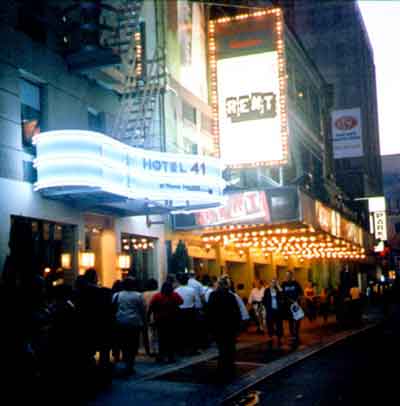 Crowds line up
to see the long-running Rent.
Crowds line up
to see the long-running Rent.
When Rent proved a bona fide sensation in 1996, some critics said that it pointed the way to Broadway's musical future. Well, after a full decade, it is clear that these pronouncements were misfires. With amateurish production values, lust labeled as love, and bathos where a plot should be, Rent is less a signpost than a stumble. After almost a decade, it has spawned no trends, leaving nothing in its wake but the commercially unsuccessful rock-flavored stage adaptations of Footloose, Saturday Night Fever and Bright Lights Big City. If style, romance, melody and joy are things of the past, what is the point of a musical? Why not just go to a rock concert?
It astounds me that the super-exclusive circle of Pulitzer Prize winning musicals (Of Thee I Sing, South Pacific, Fiorello, How To Succeed, A Chorus Line) a circle that lacks My Fair Lady and Fiddler on the Roof now includes Rent. What kind of madness is that? Rent's original New York subway advertising proclaimed, "Don't you hate the word 'musical'?" As a musical theatre lover, I will toast the day that this cacophony closes – despite the fact that it was the last Broadway production I was personally involved with.
Since 2000, the all-American musical comedy has made a stunning comeback. With the triumph of The Full Monty, The Producers, Urinetown, Thoroughly Modern Millie and Hairspray, critics and audiences have re-embraced a genre many (this author included) had supposed dead. With the exception of Urinetown, they are based on hit films. Musicals have been inspired by movies for decades, but not with such concentrated success. These musical comedies show tremendous promise, offering a happy blend of nostalgic pastiche and original spoof. They have also turned long-empty hopes into filled theater seats – the ultimate sign of a successful theatrical trend.
It is almost impossible to overestimate the role musical theatre plays in the economic life of New York City. Figure in what theatergoers spend at hotels, restaurants and stores, and it is estimated that Broadway contributes four and a half billion dollars to New York's economy. Off-Broadway musicals add millions more to that figure. That's a lot of income from a supposedly dead or dying art form! And in terms of the theatre itself, according to a study released by the League of Theatre Owners and Producers, nine out of every ten dollars spent on Broadway tickets are spent on admission to musicals.
And Film Musicals?
Animated musicals were one of the most lucrative screen genres of the 1990s, and several of those feature length cartoons have mutated into Broadway stage versions. While the results may be artistically questionable, they certainly keep millions of people listening to show tunes. The success of the live action films Moulin Rouge (2001), Chicago (2002) and Dreamgirls (2007) show that innovative directors can still make film musicals profitable, fresh and exciting. At the same time, the costly failures It's Delovely (2004), Phantom of the Opera (2005), The Producers (2005) and Rent (2005) prove that Hollywood is still too willing to rely on empty production values rather than on quality material and intelligent presentation.
You're Hedging! Is the Musical Dead?
 At
New York's St. James Theatre, ticket buyers
fork over more than $100 a seat or more to see The Producers.
At
New York's St. James Theatre, ticket buyers
fork over more than $100 a seat or more to see The Producers.
If it sounds like I'm hedging, I'm not alone. Musical theater historian Denny Martin Flinn wrote –
"When A Chorus Line gave its final Broadway performance fifteen years after it opened, the last great American musical went dark, and the epoch was over."
- Musical! A Grand Tour (New York: Schirmer Books, 1997), p. xiii
But by his book's end, he borrows a bit of a Jerry Herman lyric to reassure us that –
"A light, however dim, shines at the end of the tunnel. . . After two decades of domination by heavy-handed entertainment without substance, style or sense, perhaps the American musical theater will still be here tomorrow – alive and well and shining."
- Flinn, pp. 494-495
The Producers, Thoroughly Modern Millie, Urinetown and Hairspray succeeded by doing what great musical comedies have always done – approach material in fresh and funny ways no one has attempted before. (Male strippers, singing Nazis, bathroom politics and interracial romance would have been unthinkable in the so called classic musicals of the 1950s!) At the same time, several Broadway revivals have taken new approaches to well-known material, infusing classics with fresh energy.
Is this really a new "Springtime" for musical comedy on Broadway, or just a momentary thaw? Only time will tell. For this trend to last, we need an army of new talents to keep new hits coming - and an audience large enough to make the results profitable. One wonders how many creative people will be willing to attempt the costly, high-risk process of creating musicals for Broadway in years to come – especially when film and television offer far more lucrative employment. A hit musical takes years to pay its creators anything like the six figure income a sitcom writer earns in just one season.
There is also the ongoing trend of "jukebox musicals" -- shows built around an existing catalog of old pop songs. These range from plot-based book musicals (Mamma Mia, All Shook Up) to essentially plotless semi-revues or dance musicals (Movin' On). Contact (2000) mixed classical and pop recordings, dispensing with any songwriters, live musicians or singers -- and still managed (in a feeble season) to win the Tony for Best Musical. While traditionalists may not be happy with jukebox musicals, it is hard to deny that the best of them sell lots of tickets on Broadway and on tour. So long as the money keeps flowing in, this trend will continue. One can only hope it does not reach the point where Broadway turns into Las Vegas East.
AHEM! Is The Musical Dead?
All right, it is time for a direct answer . . . Dead? Absolutely not! Changing? Always! The musical has been changing ever since Offenbach did his first rewrite in the 1850s. And change is the clearest sign that the musical is still a living, growing genre. Will we ever return to the so-called "golden age," with musicals at the center of popular culture? Probably not. Public taste has undergone fundamental changes, and the commercial arts can only flow where the paying public allows.
But the musical is far from dead. It will survive, and occasionally thrive, by adapting to changes in artistic and commercial expectations. But change often comes at a price. The new century will take musical theatre and film to places we could no more imagine than the people of the early 1900s could have foreseen the technology of The Jazz Singer or the subject matter of Hedwig and the Angry Inch. As it moves forward, the musical will go places some of us may not care to follow. But so long as a song helps to tell a story, musicals will be around.
Just as we opened this series of essays with a definition of the musical, so now we close with another. This one is courtesy of Oscar Hammerstein II –
"It is nonsense to say what a musical should or should not be. It should be anything it wants to be, and if you don't like it you don't have to go to it. There is only one absolutely indispensable element that a musical must have. It must have music. And there is only one thing that it has to be – it has to be good."
- as quoted by Stanley Green in The World of Musical Comedy (New York: Ziff Davis Publishing, 1960), p. 7.