
G&S101
The Gilbert and Sullivan Story
by John Kenrick
Copyright 2000 (Revised 2020)
(All the photos below are thumbnails – click on them to see larger versions.)
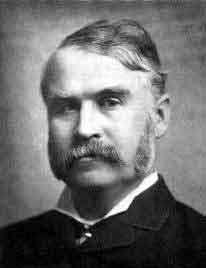
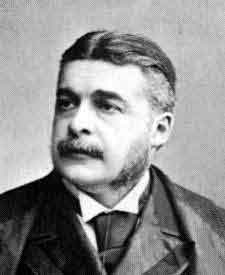

William Gilbert – Arthur Sullivan – Richard D'Oyly Carte

Beginning in the 1870s, three Englishmen -- playwright William S. Gilbert and composer Arthur Sullivan --revolutionized the musical theatre, creating a series of witty, melodic operettas that set a new standard for stage professionalism. Sullivan's music sparkled with fresh melody, and Gilbert's librettos blended silliness and satire in settings that ranged from pure fantasy to the utterly realistic. Innovative producer Richard D'Oyly Carte publicized these shows as "light operas", but by any name, they were musicals – some of the finest the world would ever see in any language.
Beginnings
Gilbert was an unsuccessful attorney before a series of his comic poems (illustrated by his own line drawings) were published in several popular British magazines. This opened the way to a successful career as a London playwright and director. At the same time, Sullivan was winning acclaim as Britain's most promising serious composer, but he composed lighter pieces to cover the expenses of the high-society lifestyle he craved. Both men had written minor musical shows with other collaborators, but neither expected to find lasting fame for their work in musical theatre.
In the 1860s, the British musical theatre consisted of variety shows, French operettas, and slapdash comic light operas like those presented by John Hollingshead at his Gaiety Theatre. Hollingshead hired Gilbert and Sullivan to create Thespis (1871 - 63 performances), a mythological spoof involving a theatrical troupe that stumbles onto Mount Olympus and trades places with the aging Greek gods. Written and staged in five frantic weeks, Gilbert himself later dismissed this show as "crude and ineffective," but it impressed at least one audience member – aspiring producer Richard D'Oyly Carte. Four years later, when Carte needed a one-act "curtain raiser" to share the bill with his production of Offenbach's La Perichole at London's Opera Comique, he convinced Gilbert and Sullivan to adapt one of Gilbert's satirical poems.
Trial By Jury: The Curtain Raiser
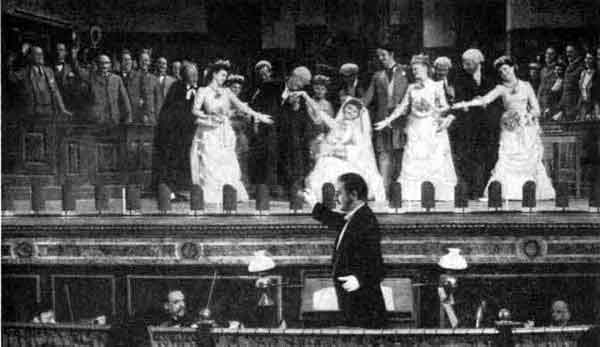 The opening
night of Trial By Jury as recreated on the big screen for
The Gilbert and Sullivan Story.
The opening
night of Trial By Jury as recreated on the big screen for
The Gilbert and Sullivan Story.
The resulting thirty five minute musical eclipsed La Perichole and became the talk of London. Trial By Jury (1875 - 131) was a delicious spoof of a breach of promise trial, a Victorian-era legal action in which a man could be sued by a woman for withdrawing a proposal of marriage. In the show, the defendant is a roguish playboy, the pretty plaintiff (wearing her wedding dress) flirts shamelessly with the all-male jury, and an amoral judge resolves the case by announcing he will marry the girl himself.
Trial By Jury established several comic themes that would run through Gilbert and Sullivan's shows –
- Unqualified men who have oiled their way into high public office
- The course of true love flows in surprising directions
- A flagrant disdain for women over 40 years of age
Example: Trial's "Learned Judge" (originally portrayed by Sullivan's brother Frederic) sings of the questionable tactics that brought him to his exalted position --
At Westminster Hall
I danced a dance,
Like a semi-despondent fury;
For I thought I never
Should hit on a chance
Of addressing a British Jury.
But I soon got tired
Of third-class journeys,
And dinners of bread and water;
So I fell in love
With a rich attorney's
Elderly, ugly daughter.The rich attorney,
He jumped with joy,
And replied to my fond professions:
"You shall reap the rewards
Of your pluck, my boy,
At the Bailey and
Middlesex sessions.
"You'll soon get used
To her looks," said he,
"And a very nice girl
You will find her!
She may very well pass
For forty-three
In the dusk,
With a light behind her!"
Although both Gilbert and Sullivan initially considered operetta a sideline, they realized it could prove very profitable. So D'Oyly Carte had no trouble persuading them to attempt a full-length work.
The Sorcerer
 George Grossmith, who
originated most of the G&S comic "patter" roles
– seen here as John Wellington Wells in The Sorcerer.
George Grossmith, who
originated most of the G&S comic "patter" roles
– seen here as John Wellington Wells in The Sorcerer.
The Sorcerer (1877 - 178 performances) involved title character John Wellington Wells, who wreaks havoc in a small English village with a love potion. By having members of the upper and lower classes fall in love with each other, The Sorcerer lampooned Victorian notions of class distinction, but it's comedy was so polished, witty and utterly respectable that no one took offense. It had a healthy run, and unauthorized productions soon appeared in the United States, which at that time did not recognize international copyrights.
Gilbert and Sullivan were initiating a form of British operetta that was quite unlike the works of Offenbach. Where French operettas had cartoonish characters, G&S made an effort to use more familiar, believable characters. Most of the townspeople in The Sorcerer were the sort that British audiences knew from everyday life -- with the obvious exception of the title character. And there were no sexual references.
Encouraged by The Sorcerer's profitable run, the authors wrote an operetta that had even greater fun with British social conventions. This one would succeed beyond their wildest dreams, reshaping the popular musical theatre on both sides of the Atlantic.