
Jolson 101
Al Jolson: A Biography
by John Kenrick
(Copyright 2003)
(All the photos on this page are thumbnail images – click on them to see larger versions.)
Beginnings
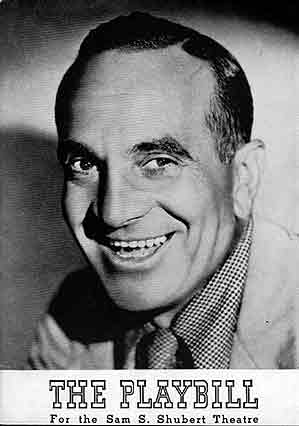 Al
Jolson as he appeared on the program cover for the
Broadway musical Hold On to Your Hats (1940). By then, he had come a long
way from his childhood in Tsarist Russia.
Al
Jolson as he appeared on the program cover for the
Broadway musical Hold On to Your Hats (1940). By then, he had come a long
way from his childhood in Tsarist Russia.
Asa Yoelson was born in Seredzius (a.k.a. Srednike), a Jewish village ("schtetle") in the Lithuanian region of Imperial Russia. Although he would claim Mar. 26, 1886 as his birth date, no documentation exists to verify it – it may have been anytime from 1884 onwards. The openly anti-Semitic authorities were not interested in recording the arrival of another Jew. Asa was the fourth surviving child of cantor Moshe Yoelson and his wife Naomi, after daughters Rose and Etta, and their son Hirsh. The Yoelsons raised their family according to strict orthodox tradition, and Moshe expected his sons would one day become cantors too. He trained both boys to sing, propping open their mouths with matchsticks to encourage them to sing loud and clear.
Moshe Yoelson wanted to get his family away from the ongoing threat of Tsarist oppression. Soon after Moshe's studies brought him the title of rabbi in 1890, he traveled to America, promising to send for his wife and children at the earliest opportunity. The emotionally strong but physically ailing Naomi held the family together, becoming the center of young Asa's world. When Moshe became head of a Washington D.C. congregation in 1894, Naomi and the children made the long journey to join him there. Any hopes the Yoelson's had of resuming a normal family life were dashed when Naomi's died in 1895. Eight year old Asa was in the next room, his world shattered.
"Asa Yoelson would never be the same again. He grew up in that moment – probably as much as he would ever grow up. Al Jolson, for all his tough, earthy exterior, would remain an emotional child for the rest of his life – a self assured braggart who was terrified of being alone, a sentimentalist with a heart of gold who made life miserable for those around him, and a lothario who chased, conquered, and in turn ignored young women. In short, a man-boy, full of seeming contradictions and haunted by the specter of his mother's death."
- Herbert G. Goldman Jolson: The Legend Comes to Life (New York, Oxford Univ. Press, 1988), p. 9.
Asa and his brother Hirsh soon immersed themselves in American culture, learning the ragtime songs performed on the streets and in the saloons of Washington. Moshe did what he could to keep his sons in line. To restore some semblance of a happy home, he married Cheysa Yoels (a.k.a. "Hessi"), an old neighbor from Seredzius who had genuine affection for the children. But nothing could keep the Yoelson boys from embracing a new way of life. Hirsh changed his name to Harry, and Asa became Al. Both boys ran away from home several times. At one point, Al spent several weeks at St. Mary's Industrial School for orphaned boys in Baltimore.
The Yoelson brothers both became obsessed with breaking into show business. Al sang in a traveling circus (1899), then toured in burlesque and vaudeville beginning in 1901. As part of an "illustrated singing act," he performed popular favorites while a series of lantern slides were projected on a sheet. Al and Harry managed to get bookings with a crude ethnic comedy act called "The Hebrew and the Cadet." They also changed their last name to "Joelson," and then the even less ethnic "Jolson." Wheelchair-bound comic Joe Palmer recruited the Jolsons for a three-man vaudeville comedy act that showed promise, but Al's self-conscious performances were holding them back.
Blackface
In 1904, while playing an engagement at Keeney's Theatre in Brooklyn, Al started performing in blackface, supposedly at the suggestion of veteran blackface comedian James Francis Dooley. Working behind a burnt cork mask gave Al a sense of freedom and spontaneity he had never known before. The act became a surefire laugh-getter, and was soon booked on vaudeville's Orpheum circuit.
Blackface was not considered racially offensive in the early 1900s. White men smearing their faces black and imitating African Americans had been common on American stages since the 1830s, and was just one form of the coarse, humor that all racial and ethnic groups were subjected to at that time. We have no reason to believe Al Jolson's use of blackface was motivated by anything other than a desire to entertain. He was never known to express racist attitudes, and often went out of his way to befriend black performers who were subjected to segregation in theatres, hotels and restaurants. I am not defending blackface, a convention most people consider unthinkable today. However, I am suggesting Jolson's use of blackface is best understood in the context of his era. He was not making a statement; he was hiding behind a mask – a mask that gave him an extraordinary sense of confidence while on stage.
"Jewish entertainers also put on blackface for another reason. According to Ronald Sanders, both groups felt a deep woe, had suffered at the hands of oppressors, and lived close to their pain. Many of the new songs hailed the brighter day and the aggressiveness necessary to live in the new land, but the singers invested blackface with a plaintive note, which kept them in touch with their past though with the pain once removed, hidden behind a black face."
- Lewis A. Erenberg, Steppin' Out: New York Nightlife and the Transformation of American Culture 1890-1930 (Chicago: University of Chicago Press, 1991), p. 195.
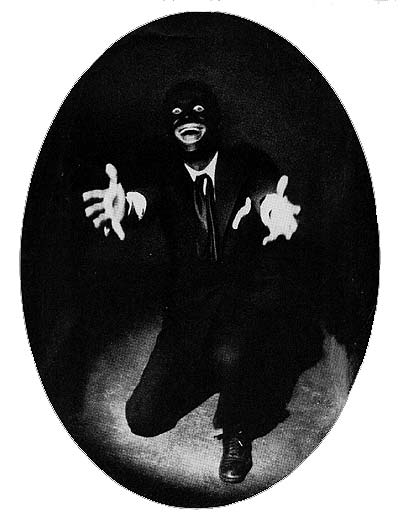 Al
Jolson in full blackface singing down on one knee -- one of his most
celebrated poses on stage.
Al
Jolson in full blackface singing down on one knee -- one of his most
celebrated poses on stage.
Harry Jolson eventually withdrew from the act to go it on his own. Palmer toured with Al for a time, but retired when he became convinced that he was holding Al back from stardom. In 1906, Al Jolson's solo career as a "singing comedian" began. He wore blackface with a dark suit, black shoes, white socks and gloves, and his mouth outlined in white. This drew maximum attention to his hands and mouth, the key tools for any vaudeville singer. A triumphant engagement in San Francisco made him a top star on the Western circuits. This was no small accomplishment. Smoking was still allowed in most theatres, and customers often paged through newspapers until something on stage demanded their attention. Electronic sound systems had not been invented yet, so performers had to rely on all sorts of tricks to catch an audience's attention. Jolson knew them all, and even invented a few of his own. He danced, stamped, cried real tears, improvised risqué jokes and outrageous physical gags – even sashayed about with wildly effeminate gestures. Once he had an audience, Jolson wouldn't let go until they were begging for more.
First Marriage: Henrietta Keller
California native Henrietta Keller was an eighteen year old dancer with shapely legs and a shy smile. Twenty year old Al became infatuated, relentlessly courting Henrietta and her family. After nearly a year of refusals, Henrietta accepted Al's umpteenth proposal. They were married in September 1907. Henrietta would soon learn that she had tied the knot with one of the most maddening, self-centered men on earth.
Jolson continued to win raves in vaudeville, but he could not resist when Lew Dockstader offered him a chance to star in America's last great minstrel troupe. He took a major cut in salary to become Dockstader's second comedian in 1908, knowing it would open the way to greater opportunity. Audiences adored Jolson's antics. When the troupe played New York, he got the kind of acclaim he had always dreamt of. He went off to play a series of solo vaudeville engagements on the Orpheum circuit, and returned to Dockstader to tour in 1909. It was at this time that Jolson started whistling on stage, using loud melodic whistle trills to punctuate songs and gags. It would remain a trademark throughout his career. He was also working closely with musician Harry Akst, who became Jolson's ever-handy accompanist, song selector and personal crony.
Al was already showing signs of the colossal ego that would mark him for the rest of his life. When Florenz Ziegfeld extended an invitation to audition for the Follies, Jolson refused. Most performers would have leapt at such an opportunity, but Jolson insisted that he did not audition for anybody. Jolson returned to touring the UBO and Orpheum circuits in 1910, and played a vaudeville engagement at Hammerstein's Victoria in New York in February 1911. He was already in rehearsals for his Broadway debut.
Broadway Debut
The Shubert Brothers were opening their handsome new Winter Garden Theatre with a lavish production, La Belle Paree (1911 - 104). This musical about a wealthy widow gallivanting around Paris was just an excuse for a succession of variety acts. With a curtain-raising one act comic opera tacked on, the over packed show opened on March 20th, 1911, and ran over four hours. Jolson suffered from crippling nerves on opening nights – a habit that only deepened over time. He won only a moderate response from the exhausted first night audience, but that changed as the Shuberts rearranged the show in the days that followed. Between the better placement of Al's solos and his personal determination to succeed, he was suddenly stealing the show.
Jolson kept introducing new gags and new verses to his songs, and audiences kept coming back to see what he would do from week to week. A show that had begun as an all-star cavalcade gradually became Jolson's personal vehicle. By the time the summer heat forced La Belle Paree to close in June, Jolson was the hottest new star in show business.