
A History of The Musical
The British Music Hall
by John Kenrick
(The images below are thumbnails – click on them to see larger versions.)
A Song and a Pint
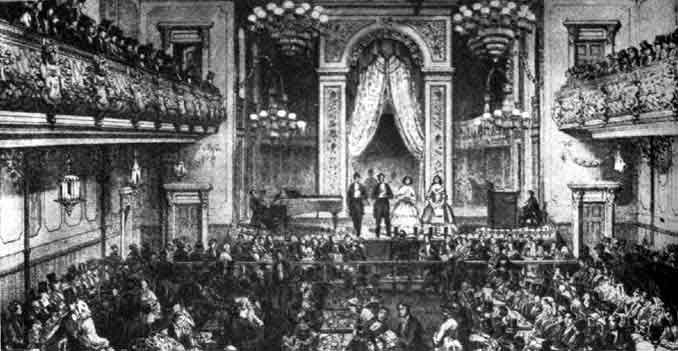 Weston's Music Hall
(one of the earliest) sometime in the 1880s. Note the long tables where patrons
ate and drank during performances.
Weston's Music Hall
(one of the earliest) sometime in the 1880s. Note the long tables where patrons
ate and drank during performances.
British taverns had provided musical entertainment since medieval times, and outdoor musical "pleasure gardens" flourished in the 1700s. The early 1800s brought "saloons" offering variety acts and booze, with some going so far as to add theatres to their original structures. When the Theatre Act of 1843 declared that such establishments would only be licensed if run as theatres, the first music halls appeared in suburban London. Although the stress was on entertainment, alcohol flowed, to the delight of customers and the ongoing profit of proprietors.
As Great Britain's Industrial Revolution created a new urban working class in the mid-1800s, the music halls provided this new audience with inexpensive entertainment. In time, intellectuals and the upper classes took a liking to these unpretentious variety shows. By 1875 there were over three hundred music halls in London, with hundreds more scattered across the British Isles. With names like The Empire or The Hippodrome, they became favorite hangouts for people of every class and persuasion.
In time, all music hall performances followed a basic format. A "Chairman" acted as master of ceremonies, introducing singers, dancers and specialty acts (magicians, etc.). The halls were everything from huge ornate theaters to stuffy converted basements. All that was required was a stage, audience seating, and a strategically placed bar.
Atmosphere
While everyone went for the music and comedy, there is no question that the availability of liquor was part of the music hall's appeal. The temperance movement complained that the halls encouraged heavy drinking among both men and (gasp!) women, particularly among (oh, horror!) the lower classes. A few booze-free halls opened but soon faded. The British public went to the music halls to kick back and have a good, rowdy time, not a subdued experience.
Instead of a proscenium stage, some of the earliest music halls looked like churches, with a fenced-in sanctuary for the performance area and pipe organs to accompany the singers. But the atmosphere was far from prayerful! Audiences were seated on benches surrounding huge plank tables, where they could eat, drink, read, and settle in for hours. Performers were often ignored as business deals, political debates, romantic assignations and a general hubbub filled the air. Every act had to deliver solid entertainment – or else!
The audience often joined in singing popular songs, and cheered-on favorite performers. Mediocre acts were booed off the stage, but these rejections were more spirited than vicious. Those who were not tough enough to take such treatment soon sought other forms of employment.
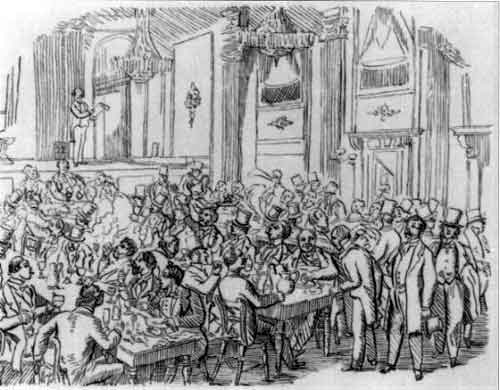 A period illustration of the plight faced
by early music hall performers. Imagine facing this noisy mob in the days before
sound systems!
A period illustration of the plight faced
by early music hall performers. Imagine facing this noisy mob in the days before
sound systems!
With women and children in the audience, the material was never more than mildly risque. Most music hall songs were sentimental and/or comic takes on everyday life, as well as spoofs of the rich and famous. A classic example is Marie Lloyd's popular hit, "My Old Man" –
We had to move away
Cause the rent we couldn't pay.
The moving van came round;
This after dark.
There was me and my old man
Shoving things inside a van,
Which we've often done before,
Let me remark.
We packed all that could be packed
In the van, and that's a fact,
And we got inside
All we could get inside.
We packed all that could be packed
On the tailboard in the back,
Till there wasn't any room;
For me to ride.And my old man
Said, "Run along the van,
And don't dilly-dally on the way."
On went the van with my whole billet.
I'd run along with me old cock-a-linnet.
A-dillying, I dallied;
A-dallying, I dillied.
I lost the way and
Don't know where to roam.
Who's gonna put up
The old iron bedstead
If I can't find my way home?
Popular Stars
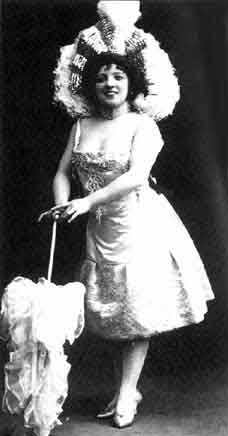 Surviving recordings make it clear that few music hall stars had
good voices. Like their vaudeville counterparts in the U.S., their primary
qualifications were energy and personality. The best music hall performers had
both in abundance. Marie Lloyd (seen at left) was one of the most beloved
music hall stars. Her stage humor ranged from the wholesome to the risqu'. If her
trademark parasol failed to open, she would quip, "I haven't had it up for
ages." One of her songs was "She Sits Among Her Cabbages and Peas"
– a title that sounds less innocent than it looks. Lloyd always adapted her
act to the audience at hand, winning almost universal affection. Playwright and
poet T. S. Eliot explained her appeal this way –
Surviving recordings make it clear that few music hall stars had
good voices. Like their vaudeville counterparts in the U.S., their primary
qualifications were energy and personality. The best music hall performers had
both in abundance. Marie Lloyd (seen at left) was one of the most beloved
music hall stars. Her stage humor ranged from the wholesome to the risqu'. If her
trademark parasol failed to open, she would quip, "I haven't had it up for
ages." One of her songs was "She Sits Among Her Cabbages and Peas"
– a title that sounds less innocent than it looks. Lloyd always adapted her
act to the audience at hand, winning almost universal affection. Playwright and
poet T. S. Eliot explained her appeal this way –
"No other comedian succeeded so well in giving expression to the life of the music hall audience, raising it to a kind of art. It was, I think, this capacity for expressing the soul of the people that made Marie Lloyd unique."
- Selected Essays by T. S. Eliot, Faber and Faber, London, 1941
After World War I, food service disappeared from the music halls, and traditional theatre seating replaced the old benches and tables. But there was still plenty of beer! Performers faced more concentrated scrutiny, which only strengthened the popularity of favorites like comic singers Florrie Forde, George Robey and Harry Champion. Most performers preferred songs with simple repetitive refrains that were easy for audiences to remember and sing along with. Champion's repertoire included this cockney refrain –
I'm 'Enery the Eighth I am,
'Enery the Eighth I am, I am.
I got married to the widow next door –
She's been married seven times before.
Ev'ry one was a 'Enery
She wouldn't 'ave a Willie or a Sam.
I'm her eighth old man named 'Enery –
'Enery the Eighth I am!
Music hall performers found their comedy in the kind of characters and situations that audiences encountered as part of their everyday lives.
"The police, the rent collector, the bailiffs, mothers-in-law, the drunken husband and the shrewish wife, the spendthrift who had gambled away his pay before he got home Friday night – such were the dragons slain by these seedy St. Georges. Patriotism and the more chauvinistic aspects of Victoriana were pandered to and at the same time subtly ridiculed; the rednecks were kept happy and, for those with the wit to see it, the satire was there."
- Peter Leslie, A Hard Act to Follow: A Music Hall Review (London: Paddington Press, 1978), p. 47.
Curtain
Music halls went into a gradual decline after the introduction of talking films, but the British never did let a good habit die easily. Some halls were still in operation after World War II, and the best music hall songs are still sung in some London pubs. The music halls gave the British public a solid tradition of popular musical theatre. Stage stars Vesta Tilley, Lupino Lane and Gracie Fields as well as film legends Stan Laurel and Charlie Chaplin got their start in the music halls.
In the United States, two forms of musical revue developed during the mid-1800s. One was bawdy and the other was the embodiment of racism, but both flourished for decades and were the precursors of musical theatre in America.