
Ziegfeld 101
Ziegfeld Who's Who: A to L
by John Kenrick
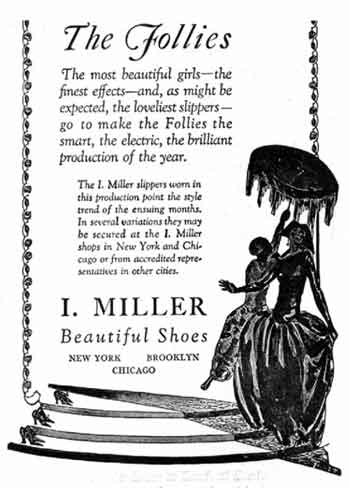 A 1920s Playbill advertisement.
Anyone affiliated with the Follies boasted about it, including the
famous shoe maker
I. Miller, whose landmark building still stands on Times Square. Click on
the image to see a larger version.
A 1920s Playbill advertisement.
Anyone affiliated with the Follies boasted about it, including the
famous shoe maker
I. Miller, whose landmark building still stands on Times Square. Click on
the image to see a larger version.
Below you'll find mini-profiles of people who figured prominently in Ziegfeld's life and career. In many cases, there are links to more detailed bios in Musicals101.com's "Who's Who in Musicals" section.
Bayes, Nora (1880-1928) - Popular singer who introduced "By the Light of the Silvery Moon" in the Follies. Detailed biography.
Berkley, Busby (1895-1976) - The big screen's most acclaimed choreographer first grabbed Hollywood's attention with his dances for the screen version of Ziegfeld's Whoopee. Detailed biography.
Berlin, Irving (1888-1989)- This much loved composer-lyricist composed many songs for the Follies, most notably "A Pretty Girl is Like a Melody," the so-called theme for the series. Detailed biography.
Brice, Fanny (1891-1951)- Torch singer and peerless comedienne, Brice starred in more editions of the Follies than anyone else. Detailed biography.
Buck, Gene (Aug. 6, 1885 - Feb. 25, 1957) - This versatile talent became Ziegfeld's right hand, acting as lyricist, script writer and director for many editions of the Follies, from 1911 through 1931. Buck "discovered" such Follies luminaries as Will Rogers, W.C. Fields and designer Joseph Urban. Buck was also a co-founder and longtime president of the composer's association ASCAP. Detailed biography.
Burke, Billie (b. Aug 7, 1885 -d. May 17, 1970) American born and raised in England, this ravishing redhead's vivacious charm made her a favorite ing'nue in a series of stage musicals and comedies produced by Charles Frohman in London and New York during the early 1900s. When Burke met Ziegfeld at a New Year's gala, it was love at first sight for both of them. They were married in 1914, and had a daughter, Patricia, two years later. Burke was infuriated by Ziegfeld's frequent infidelities, but their love kept the marriage going. A popular film star, she brought Ziegfeld out to Hollywood when his fortunes and health deteriorated. After his death, she worked for years to clear Ziegfeld's debts and maintain his legacy. She co-produced two further editions of the Follies with the Shuberts, and acted as consultant for MGM's acclaimed film The Great Ziegfeld. She became Hollywood's favorite feather-brained matron in dozens of screen comedies, including Dinner at Eight (1933), Topper (1937) and The Man Who Came to Dinner (1942). Best remembered as Glinda in The Wizard of Oz (1939), Burke remained active in films until 1960. Her autobiography was entitled With a Feather on My Nose (1948).
Cantor, Eddie (1892-1964) - A brilliant comic actor and singer, Cantor appeared in several editions of the Follies, as well as the Ziegfeld musical comedy hit Whoopee. In 1927 he became the only solo star of a Follies during Ziegfeld's lifetime. Detailed biography.
Carroll, Earl (1893-1948) - Producer of a series of revues called Vanities and Sketchbooks, Carroll was one of Ziegfeld's most successful competitors. When the Depression forced Carroll into bankruptcy, Ziegfeld took over Carroll's theater – only to face his own financial collapse months later. Detailed biography.
Charlot, Andre (1882-1956) - This Paris native produced a series of chic, intimate 1920s London revues that traveled to Broadway. They were successful alternative to Ziegfeld's lavish productions. Charlot introduced America to such talents as Beatrice Lillie, Jack Buchanan and Gertrude Lawrence, and showcased the early songs of Noel Coward. Detailed biography.
Dolly Sisters - Identical Hungarian twins Jenny and Rose(born Yansci and Rozika Dutsch) became famous in vaudeville, and were the longest running sister act ever to play The Palace. Poor singers and limited dancers, their physical beauty and elaborate costumes were the key to their lasting popularity. The appeared in several editions of the Follies and Midnight Frolic. Both married millionaires and retired in the late 1920s.
Dolores (1892-1975) - born Kathleen Rose, this tall English beauty was a popular fashion model when Ziegfeld hired her for the 1917 Follies. Although she could neither sing nor dance, her extraordinary looks made her a favorite, and she appeared in various Follies and Frolics walking across the stage in spectacular costumes. She appeared in the long-running Sally before retiring to marry a millionaire.
Duke, Vernon (1903-1969) - This sophisticated composer contributed melodies to several editions of the Follies. Detailed biography.
Eaton, Mary (1901-1948) - This gifted dancer toured for the Shuberts and appeared in the ensembles of several Broadway musicals before Ziegfeld groomed he to be Marilyn Miller's successor in the Follies. She appeared three editions (1920-1922), co-starred with Eddie Cantor in Kid Boots (1923), and headlined The Five O'Clock Girl (1927). On screen, she appeared with the Marx Brother in Coconuts (1929) and starred in Ziegfeld's Gloryfying the American Girl (1929). After retiring into private life, Eaton died of a heart attack at age 47.
Erlanger, A.L. (1860-1930) - The most powerful American theater owner of the 19th Century, Erlanger co-produced the early Follies and many other shows with Ziegfeld. He also built and owned The New Amsterdam, home to many of Ziegfeld's hits. Detailed biography.
Errol, Leon (1881-1951) Born in Australia, Errol honed his comic skills touring in American burlesque before making his Follies debut in 1911. He starred and even directed several more editions, and starred with Marilyn Miller in the long running hit Sally. Detailed biography.
Etting, Ruth (1896-1978) - This popular torch singer won fame in nightclubs and vaudeville before introducing the hit "Shaking the Blues Away" in the 1927 Follies. She sang "Love Me or Leave Me" in Whoopee, "Ten Cents a Dance" in Simple Simon, and recreated the old Nora Bayes hit "Shine On Harvest Moon" in the 1931 Follies. Etting's colorful life was depicted in the hit film Love Me or Leave Me. Detailed biography.
Fairbanks Twins - Madeline and Marion were Broadway favorites from their childhood, They danced in several editions of the Follies and the Midnight Frolics.
Friml, Rudolph (1979-1972) - One of Broadway's most successful operetta composers, Friml contributed songs to several editions of the Follies, and composed the score for Ziegfeld's hit musical version of The Three Musketeers. Detailed biography.
Gray, Gilda (1901-1959)- born Marianne Michalski, this Polish dancer popularized the "shimmy" – a ragtime dance craze of the early 1920s. She danced in the 1922 Follies. The film Gilda (1949), starring Rita Hayworth, was inspired by her colorful life. Gray died of a heart attack at age 58.
Haggin, Ben Ali (1882-1951) - A prominent portrait painter, Haggin devised a series of tableau called "Living Pictures" for both the Midnight Frolic and the Follies. Thanks to a legal technicality, nudity on stage was legal so long as the performers did not move. Showcasing Ziegfeld's chorus beauties in costly but minimal costumes, these recreations of famous paintings were very popular. Haggin also designed costumes for various editions of the Follies.
Hammerstein II, Oscar (1895-1960)- Lyricist and librettist, he collaborated with composer Jerome Kern on the epic Show Boat. Detailed biography.
Held, Anna (1873?-1918) - With an hourglass figure, expressive eyes and coquettish charm, this Polish born singer won stardom in the music halls of England and France. Ziegfeld wooed her, becoming her common law spouse while producing a series of popular musical star vehicles for her. A musicalized revival of A Parlor Match (1896) was followed by such hits as Papa's Wife (1899), Mam'selle Napoleon (1903) and Miss Innocence (1908). Ziegfeld also made Held the focus of several outrageous publicity gimmicks, including phony jewel heists and the ludicrous suggestion that she only bathed in fresh milk. Held's hit songs included ""I Just Can't Make My Eyes Behave" and "It's Delightful to Be Married." Ziegfeld's flagrant infidelities (in particular with Lillian Lorraine) led a heartbroken Held to file for divorce in 1912. She toured in vaudeville and returned to Broadway in Follow Me (1916). A rare form of bone cancer led to her death at age 45. Detailed biography.
Herbert, Victor (1859-1924) - This beloved Irish-American composer of hit musical comedies and operettas contributed music for ten editions of the Follies, as well as Sally and several other Ziegfeld productions. It is said that Ziegfeld's chronic refusal to pay his composers led to the rage that killed Herbert. Detailed biography.
Kern, Jerome (1885-1945) - One of Broadway's greatest composers, Kern collaborated with Oscar Hammerstein II on the score for Show Boat. He also wrote most of the music for Ziegfeld's long running Marilyn Miller vehicle, Sally. Detailed biography..
King, Dennis (1897-1971) - The top matinee idol of the 1920s, King appeared as D'Artagnan in The Three Musketeers and as Ravenal in the 1932 Show Boat revival. Detailed biography..
Lahr, Bert (1895-1967)- One of the greatest clowns in the history of American show business, Lahr toured in burlesque and vaudeville before becoming a major Broadway and Hollywood star. He co-starred with Lupe Velez in Ziegfeld's last musical comedy, Hot-Cha. Detailed biography..
Lorraine, Lillian (1892-1955) - Born Eulallen De Jacques, this tempestuous beauty was featured in several editions of the Follies, as well as other Ziegfeld shows. She eventually toured in vaudeville and starred in shows for other producers. Ziegfeld's mistress for many years, she eluded his proposals – on one occasion, marrying her thieving chauffeur just to spite her benefactor. Lorraine's heavy drinking and violent temper ruined her career, leaving her destitute in her final years. After Lorraine's death, Ziegfeld's widow Billie Burke confessed that of all the girl's in Flo's life, she was most jealous of Lorraine, whom she believed Ziegfeld loved.
Lucille - This was the pseudonym used by British aristocrat Lady Duff-Gordon when designing ladies fashions. An international success, she provided lavish costumes for seven editions of the Follies (1915-1921) as well as Ziegfeld's The Century Girl and Sally. A leading figure in international high society for most of the early 20th Century, Lady Duff-Gordon and her husband were among the lucky few to survive the sinking of the Titanic.