
History of The Musical Stage
1900-1910: Part III
by John Kenrick
(Copyright 1996; revised 2020)
(The images below are thumbnails – click on them to see larger versions.)
Ziegfeld: Broadway's Ultimate Showman
 In
this ad found on the back of the original cast program for Show Boat,
Ziegfeld is quoted as saying that Lucky Strike cigarettes "most assuredly
protect the voice."
In
this ad found on the back of the original cast program for Show Boat,
Ziegfeld is quoted as saying that Lucky Strike cigarettes "most assuredly
protect the voice."
Florenz Ziegfeld's name has taken on legendary status. This son of a Chicago music professor produced his first Broadway musical in 1895, showcasing glamorous French chanteuse (and his common-law wife) Anna Held. There were numerous now-forgotten hits and flops before 1907,when Ziegfeld (at Held's suggestion) invented his Follies.
Ziegfeld's inspiration was the Folies Bergere, a long-running Parisian revue that used skits and songs to spoof the social and political "follies" of the day, with frequent interruptions for production numbers featuring legions of creatively under-dressed women. Ziegfeld gave this French format an American spin with handsome production values and a wholesome, attractive female chorus. The tone was elegantly sexy, never trashy.
Because the superstitious Ziegfeld considered thirteen his lucky number, he gave the early editions of his revue the thirteen letter name Follies of the Day, taken from the title of a popular newspaper column penned by librettist Harry B. Smith -- who Ziegfeld hired to write the first Follies libretto.
The Shubert Brothers had successfully staged lavish "reviews" (the initially preferred spelling) at the new Hippodrome Theatre from 1906 onwards. So competing theatre owners Klaw and Erlanger were on the lookout for something similar to fill one of their summertime rooftop theatres. They agreed to finance Ziegfeld's Follies, which used the French spelling, "revue." Ziegfeld accepted the title of producer and a set salary. Although Erlanger made suggestions, Ziegfeld was given a relatively free creative hand -- so long as he stuck to a production budget of $13,800, a small figure dictated by the show's limited three month summer run.
The 1907 Follies proved so popular and profitable that it was sent out on a post-Broadway tour. An annual institution was born. From the beginning, Ziegfeld's "girlie" show was so respectable that wives were happy to attend with their husbands. Far more elaborate than any vaudeville, it was the ultimate in variety entertainment. Ziegfeld would supervise more than twenty editions of the Follies, setting new artistic and technical standards for the professional musical theatre.
(You can find more about Ziegfeld and the Follies in the essays to come, as well as in our special site feature Ziegfeld 101.)
Williams and Walker: Black Pioneers
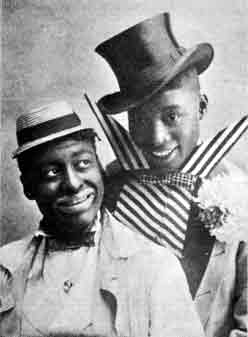 The
stars of In Dahomey, Bert Williams and
George Walker appear on the original production's sheet
music.
The
stars of In Dahomey, Bert Williams and
George Walker appear on the original production's sheet
music.
The vaudeville song and dance team Bert Williams and George Walker lead the latest wave of African-American musicals. In their act, Williams played a well-dressed conniver with Walker as his lumbering stooge. After they proved to be the highlight of the otherwise unsuccessful Broadway operetta The Gold Bug (1896), Williams and Walker starred in a series of musical comedies. Although these shows depicted blacks in a stereotypical light, the team was gradually moving toward more believable characterizations. With song, dance and laughter, they were changing attitudes:
"Although many have dismissed musical comedies as "frivolous entertainment for the tired businessman," black musical theatre retains a prime importance in Afro-American history. Around the turn of the (20th) century, musical theatre became one of the few avenues of black mobility in a white world. Within a short period, the barriers of burnt cork fell -- black actors, writers, producers, choreographers, songwriters and directors assaulted the musical theatre in order to achieve financial success but also to carve a niche for black theatrical artists and culture in a restricted field. The pace of change, though at times halting, was relatively swift . . ."
- Allen Woll, Black Musical Theatre: From Coontown to Dreamgirls (New York: Da Capo, 1989), p. xiv.
Williams and Walker achieved international success with In Dahomey (1903 - 53 performances) a musical comedy with songs by Will Marion Cook. The plot involved the duo finding a pot of gold and using their fortune to travel back to Africa. Once there, Williams (as 'Shylock Homestead') and Walker (as the conniving 'Rareback Pinkerton') triumph over several plot twists and are crowned the rulers of Dahomey, where --
Evah dahkey is a King.
Royalty is jes de ting.
If yo' social life is a bungle,
Jest you go back to the jungle,
And remember dat you daddy was a king.
White fo'k's what's got dahkey servants,
Try and get dem everything.
You must never speak insulting.
You may be talking to a king.
- as quoted in Woll's Black Musical Theatre
Degrading minstrel stereotypes were still very much in place, but Williams and Walker had turned a show written and presented by blacks into a clear financial success. The show played a brief but acclaimed run in New York. It became a long-running novelty hit in London, where its fans included members of the royal family.
Then as now, nothing impresses investors as much as commercial success, so Williams and Walker had little trouble raising the funds for Abyssinia (1906 - 31 performances), the tale of two black American lottery winners who tour Ethiopia. There was some critical grumbling about "a white man's show acted by colored men," a complaint that hampered black musicals that dared to rely on anything other than minstrel stereotypes.
Bandanna Land (1908 - 89 performances) was Williams and Walker's longest running Broadway production, but illness forced Walker into retirement before the closing night. When Williams went on to solo stardom in the Ziegfeld Follies, the black musical lost its primary proponent and the newborn form went into a quick decline. More than a decade would pass before black musicals found new life, thanks in part to the rise of the Jazz Age. (More on black musicals in an upcoming chapter.)
Some key elements were now in place -- Cohan's patriotic flair, Herbert's stylistic versatility, Lehar's call to romance, Ziegfeld's sense of high style, and the ragtime jaunt of the African American cakewalk. When a composer appeared who's work could bring the best of all these together, the American musical moved to a new creative level. For more on Jerome Kern and the changes he inspired . . .