
History of The Musical Stage
1920s: "Keep the Sun Smilin' Through"
by John Kenrick
(Copyright 1996, revised 2020)
(The images below are thumbnails – click on them to see larger versions.)
A Golden Age
 A
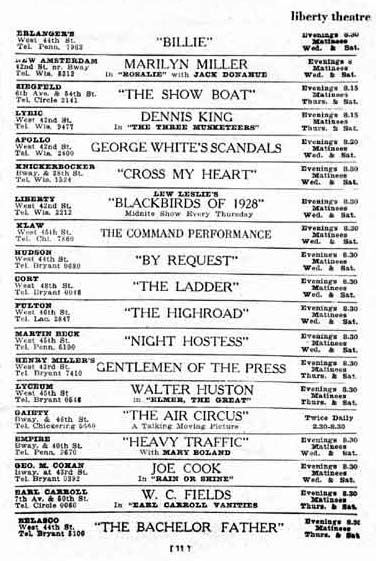
Playbill included this show listing from 1928, the busy climax of Broadway's most
production-packed decade.
A
Playbill included this show listing from 1928, the busy climax of Broadway's most
production-packed decade.
The 1920s was the busiest decade Broadway would ever know, with as many as fifty new musicals opening in a single season. With employment rates running high and incomes on the increase, record numbers of people could afford $3.50 a seat. With so much demand for entertainment, these years were a time of extraordinary artistic development in the musical theatre.
". . . the 1920s as a whole saw the the form so refine and transform itself that, by the decade's finish, the "Tee-Oodle-Um-Bum-Bo" chorus line, the Bubble Dances, the nineteenth-century comedy, and the unmotivated star shot would be virtually extinct, unknown to the better writers and unpopular even with second raters."
- Ethan Mordden, Make Believe: The Broadway Musical in the 1920s (New York: Oxford Univ. Press, 1997), p. 4.
In 1924, ASCAP (co-founded by Herbert, Cohan, Berlin, Kern and others) won a long battle to give American composers creative control over their stage scores. As unauthorized interpolations by other composers became a thing of the past, the musical began to grow in surprising ways. In September 1925, four hits opened within a space of seven days –
Vincent Youmans & Irving Caesar's No, No Nanette (321 performances), turned the story of a gently rebellious teenage girl into one of the most lasting musical comedy hits of the decade.
Rudolf Friml's romantic operetta The Vagabond King (511 performances), featured matinee idol Dennis King as a common thief who squelches a rebellion against the King Louis XI of France.
Jerome Kern, Otto Harbach and Oscar Hammerstein II's Sunny (517 performances), starred popular actress Marilyn Miller (more on this show below).
Richard Rodgers and Lorenz Hart's Dearest Enemy (286 performances), a musical comedy about a romance between a patriotic New York girl and a British officer during the American Revolution.
These shows were written by craftsmen who took operetta and musical comedy seriously, trying to provide quality entertainment while simultaneously making a profit. This approach kept the musical theatre booming. As hundreds of musicals flooded Broadway in the early 1920s, one new female star emerged to dominate the decade.
Marilyn Miller
 Marilyn
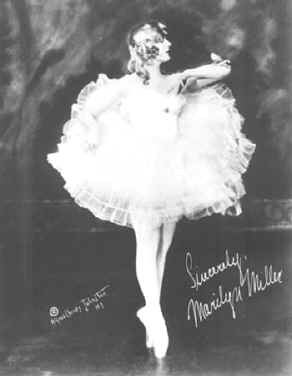
Miller dances en point in her biggest hit, Sally.
Marilyn
Miller dances en point in her biggest hit, Sally.
When producer Florenz Ziegfeld decided to build a hit in the 1920s, he spared no expense, especially when showcasing his favorite star (and sometime mistress) Marilyn Miller. A so-so singer adept at both ballet and tap, Miller's enchanting dancing persona made her Broadway's top female musical star for that decade.
Ziegfeld commissioned Miller's longest running success, Sally (1920 - 570 performances), which told the story of a poor dishwasher who rises to fame dancing in (what else?) the Ziegfeld Follies. It boasted a score by Jerome Kern (including "Look for the Silver Lining") and a Victor Herbert ballet. Follies veteran Leon Errol handled the comedy, but the triumph was Miller's. She starred in the show on Broadway for two years, toured for a third and filmed an early sound version for Hollywood in 1929. The film gives a hint of Miller's appeal -- her singing and acting seem forced, but when she dances, she is irresistible. She went on to star in two more 1920s Broadway hits –
Sunny (1925 - 517 performances) starred Miller as a circus bareback rider who loves and eventually marries a millionaire. The score, which included the hit ballad "Who?," was the first of several collaborations between Jerome Kern and the lyric writing team of Oscar Hammerstein II and Otto Harbach. A 1926 London version starring Binnie Hale and Jack Buchanan ran for 363 performances, reinforcing Kern's position as the first American composer whose shows regularly found equal acceptance in Britain and the USA.
Rosalie (1928 - 327 performances) had Miller playing a European princess who falls in love with a dashing West Point flyer. Her royal father (played by Frank Morgan) abdicates so his beloved daughter can marry her uniformed American commoner. The operetta-style score featured melodies by Sigmund Romberg and George Gershwin, including the Gershwin hit "How Long Has This Been Going On?"
The often waspish critic Alexander Woollcott offered this memorable description of Miller's Rosalie "star entrance" at the New Amsterdam Theatre --
"There comes a time once in every two or three years when the vast stage of that playhouse begins to show signs of a deep and familiar agitation. Down in the orchestra pit the violins chitter with excitement and the brasses blare. The spotlight turns white with expectation. Fifty beautiful girls in simple peasant costumes of satin and chiffon rush pell-mell onto the stage, all squealing simple peasant outcries of "Here she comes!" Fifty hussars in fatigue uniforms of ivory white and tomato bisque march on in columns of four and kneel to express an emotion too strong for words. The lights swing to the gateway at the back and settle there. The house holds its breath, and on walks Marilyn Miller."
- Review in The World, as quoted in Cecil Smith's Musical Comedy in America (New York: Theatre Arts Books, 1950), p. 268.
 Adele
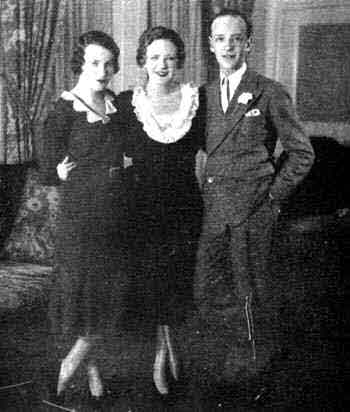
and Fred Astaire surround Marilyn Miller in this publicity photo for the musical
Smiles. They were three of Broadway's top stars in the
1920s.
Adele
and Fred Astaire surround Marilyn Miller in this publicity photo for the musical
Smiles. They were three of Broadway's top stars in the
1920s.
Charming as Miller was on stage, her volatile temper made her difficult to work with, and a childhood in vaudeville gave her a salty vocabulary. Patricia Ziegfeld recalls the day her father took her to a matinee performance of Sally. During the show, the little five year old girl thought Miller "seemed to be floating over the stage like a thistledown angel," but a backstage visit proved to be an eye opener. (Please pardon the edits, this is a family friendly site):
Miss Miller was at her dressing table putting cold cream on her face. She was still in the bugle-bead and diamante costume that she had worn in the last act. "Hello, Marilyn," Daddy said. "May we come in?"
"Hello, you lousy son of a b****," Miss Miller said. "Hello, you no-good b**t**d . . . "
"What seems to be the the trouble, Marilyn dear?" Daddy asked her. "Is something bothering you?"
"You g*d*m well know what's bothering me," Miss Miller said. "It's this piece of crap you call a costume. I've told you a thousand times it weighs a ton, and as far as I'm concerned you can take it and shove – "
-Patricia Ziegfeld, The Ziegfeld's Girl. (Boston: Little Brown & Co., 1964) pp. 183-184.
Miller co-starred with Adele and Fred Astaire in Ziegfeld's unsuccessful musical comedy Smiles (1930 - 63 performances). After a triumphant appearance in Irving Berlin's hit revue As Thousands Cheer (1933 - 400 performances), Miller did not return to the stage. A tempestuous marriage and chronic health problems drove her into premature retirement. Three years later, she died at age 37 when a quack doctor treated her sinus infection with insulin. It is fair to say Miller was irreplaceable, since all of her hits have proven impossible to revive successfully without her.
No, No, Nanette
 The
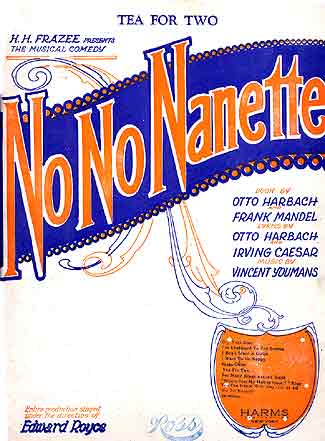
original sheet music cover for No, No, Nanette
(1925), which played at The Globe Theatre (now known as the Lunt-
Fontanne).
The
original sheet music cover for No, No, Nanette
(1925), which played at The Globe Theatre (now known as the Lunt-
Fontanne).
Musicals rarely have easy gestations, but few had as difficult and prolonged a birth as No, No, Nanette (1925 - 321 performances). When its first pre-Broadway tour stumbled in 1924, the producers brought in new stars, a new script and new songs -- in essence, creating a new show. Composer Vincent Youmans and lyricists Irving Caesar and Otto Harbach offered a hit-drenched score that included "Tea for Two" and "I Want to Be Happy."
The lighthearted coming of age plot centered on a fun-loving Manhattan heiress who gives her boyfriend the cold shoulder and defies her parents by running off to (gasp!) Atlantic City for a weekend. By the final curtain, Nanette and her man are reunited, and her bible publishing foster father mends his philandering ways. Harbach and co-librettist Frank Mandel turned this slight story into a charming laugh fest, highlighted by Youmans' sparkling melodies.
The revised Nanette was such a hit in Chicago that it remained there for more than a year. By the time Broadway saw the show, a successful London production was already running and the songs had become standards. New York critics resented this and gave the show shrugging reviews, but it still managed a to run for almost a year.
Translated into various languages, it enjoyed international success through the end of the decade. After three mediocre screen adaptations, Nanette began to fade into obscurity. Then in 1971, a nostalgic Broadway revival revamped the book, left most of the score intact and electrified audiences with some sensational choreography. In this later version, it has become the most frequently performed musical comedy of the 1920s.
The 1920s also brought a slew of revues and remarkable new composers. For more on them . . .