
History of Musical Film
1930s Part I: "Hip, Hooray and Ballyhoo"
by John Kenrick
(Copyright 1996; revised 2020)
(The images below are thumbnails – click on them to see larger versions.)
A Glut of Trash
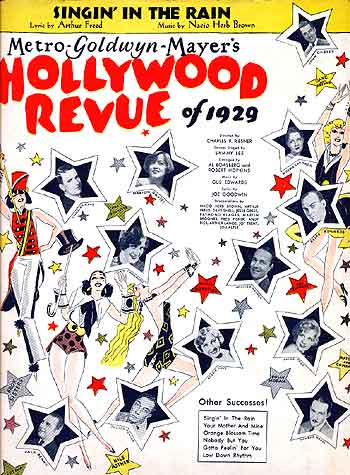 The original sheet music
cover for "Singin' in the Rain," which was introduced in MGM's all-star
Hollywood Revue of 1929. This song by lyricist Arthur Freed and composer
Nacio Herb Brown would be used in many future MGM films.
The original sheet music
cover for "Singin' in the Rain," which was introduced in MGM's all-star
Hollywood Revue of 1929. This song by lyricist Arthur Freed and composer
Nacio Herb Brown would be used in many future MGM films.
The stock market collapse of 1929 had a terrifying impact on every aspect of American culture. Several smaller studios were forced to close down, and most of the majors came close to doing the same. By 1933 almost a third of all movie theatres in the U.S. were shut down. However, the industry survived the Great Depression by meeting a very real need.
"True, the movie business would never again enjoy the figures of 1929, when 23,000 theatres were visited by an average of 95 million people a week. By 1936 the number of screens would be shaved by a third. . . The number of weekly filmgoers would also decline permanently, slashed by radio . . . Still, never was escapist entertainment needed more than during the Depression. Hollywood rose to the occasion. As the wolf settled in for a lengthy stay, entertainment provided solace and balm. But reduced prices and varied giveaways were not enough to lure people into trading hard earned pennies for filmed vaudeville. They wanted magic and romance and novelty; stories with happy endings and a chastened wolf."
- Gary Giddins, Bing Crosby: A Pocketful of Dreams, The Early Years 1903-1940 (New York: Little, Brown and Company, 2001), p. 205.
Screen musicals inherently require a substantial investment of time, talent and money, so keeping this genre alive proved a tricky proposition during the economic crash of the early 1930s. The commercial success of Love Parade and Broadway Melody spawned a glut of musical spectacles, each bigger and more clunky than the last.
Every major studio filmed at least one lavish musical revue, most to disastrous effect. The best of the bunch, MGM's Hollywood Revue of 1929, mixed weak production numbers with such oddities as Joan Crawford performing a Charleston, and silent stars Norma Shearer and John Gilbert offering an amateurish "jived up" balcony scene from Romeo and Juliet.
Hollywood's book musicals of the early 1930s could be equally bewildering. Director Cecil B. DeMille offered the only musical of his long career, Madam Satan (1930), which included a madcap costume party on a zeppelin – anything for a visual thrill. Small wonder that the public soon became disenchanted with these muddled spectacles.
Cut the Music!
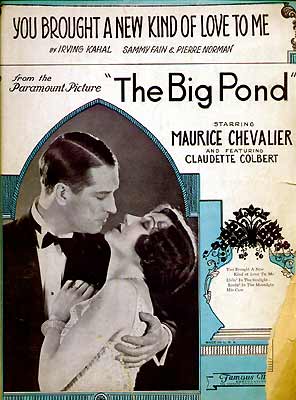 The
Big Pond was part of the glut that made audiences wary of musical films,
but it gave Maurice Chevalier the chance to introduce "You Brought a
New Kind of Love to Me."
The
Big Pond was part of the glut that made audiences wary of musical films,
but it gave Maurice Chevalier the chance to introduce "You Brought a
New Kind of Love to Me."
Thanks to rigid studio distribution systems, movie theatres were stuck showing these unappealing musicals for a week or more at a time. Financially strapped audiences started staying home. This drop in business drove most Hollywood studios to the brink of financial extinction. In a sudden twist, movie musicals were written off. They cost too much to make, so their failure was all the more painful. Theatre managers began putting up signs to assure potential ticket buyers that their latest feature was not a musical.
According to the Internet Movie Database, Hollywood released more than 100 screen musicals in 1930; only 14 in 1931. Studios went so far as to cut the songs from several musicals, turning Cole Porter's Fifty Million Frenchmen (1931) and Irving Berlin's Reaching for the Moon (1931) into awkward comedies. The few filmmakers who tried to swim against this commercial current made some fascinating, innovative films.
Marlene Dietrich: "Falling In Love Again"
As screen musicals faced oblivion, a unique star appeared with enough talent and sex appeal to soar above shifts in public taste. Marlene Dietrich's smoldering rendition of the hit song "Falling in Love Again" (the original German lyric literally translates as "From Head to Foot I'm Built for Love") in the German film The Blue Angel (Ufa - 1930) fascinated audiences on both sides of the Atlantic. Paramount Studios recognized her potential, and had this multi-talented beauty under contract before the film opened in the US.
Months later, Dietrich caused an even greater furor making her Paramount debut in Morocco (1930). Clad in a man's tuxedo, she finished an on-screen performance of a ballad by locking lips with a female admirer. Classy, beautiful, daring, and one of kind, this husky-voiced blonde became one of the most iconic screen stars of all time.
Dietrich did not appeared in full-scale musicals, preferring to interpolate a song or dance routine in almost all of her films. For example, as a frontier saloon singer in the comic western Destry Rides Again (1939), she titillated a screen full of cowboys by crooning "See What the Boys in the Backroom Will Have." An early and vehement opponent of the Nazis, Dietrich proudly performed at the front for Allied troops during World War II. Maintaining her unique sex symbol persona into her senior years, she remained a nightclub superstar until her self-imposed retirement in the 1970s.
Rodgers and Hart: "Isn't It Romantic?"
Paramount lured Broadways songwriters Richard Rodgers and Lorenz Hart to Hollywood, offering lucrative contracts and urging them to continue the innovative approach to musical comedy that had marked their stage works. After The Hot Heiress (1931), they collaborated with ground-breaking director Rouben Mamoulian on a film which most buffs consider a masterpiece – Love Me Tonight (1932).
One of this film's most memorable sequences uses a song to travel across time and space. Parisian tailor Maurice Chevalier sings the catchy "Isn t It Romantic?" to a customer – with a lyric gently spoofing the old-fashioned romantic view of love and marriage. The customer merrily hums the tune to a taxi driver, and the driver then "la-da-da's" it to a composer – who soon after is seen singing the tune to soldiers on a train. These troops are then seen singing the song as they march along a country road. A passing violinist picks up the melody and plays it for his fellow gypsies by a campfire. He is overheard by melancholy noblewoman Jeanette MacDonald on a nearby palace balcony, where she takes up the tune and sings about finding old-fashioned romance with a prince in shining armor.
A similar sense of inventiveness runs through most of Love Me Tonight. Each song propels the plot and/or develops character, sometimes in surprising ways. For example, the hit waltz "Lover" has the imperious MacDonald interspersing a love song with terse orders to her misbehaving horse. But Mamoulian's exacting methods forced production costs into the million dollar range, making it impossible for the film to turn a mid-Depression profit. As a consequence, profit-conscious Hollywood ignored Love Me Tonight's innovations.
Rodgers and Hart worked on other ambitious film projects, with disappointing commercial results. The Phantom President (1932) starred stage legend George M. Cohan in a dual role as a boring presidential candidate and a charismatic look-alike who is paid to campaign in his place. Cohan's only screen musical suffered from poorly focused political satire and fared poorly at the box office.
For Hallelujah, I m a Bum (1933) Rodgers & Hart provided another integrated score and wrote rhythmic lyrical dialogue for several scenes. Al Jolson starred as a hobo who tries to change in order to please the girl he loves. Several film historians have championed this picture, but others find it a noble experiment that failed. The dynamic Jolson as a lazy tramp? Although the use of rhyming dialog was innovative, it added little to this often dreary story. After this film did poorly with critics and audiences, Hollywood made meager use of Rodgers and Hart. The disgruntled duo left Hollywood in 1935, realizing that their best creative options were back on Broadway.
By this time, another Broadway veteran working behind the camera was reshaping the musical film into a genre the Depression-era public could not get enough of. Think big, kaleidoscopic ensembles in settings that were "naughty, gaudy, bawdy, sporty . . ."