
History of The Musical Stage
1960s II: Long Running Hits
by John Kenrick
(Copyright 1996-2003)
(The images below are thumbnails – click on them to see larger versions.)
Sunset of a Golden Age
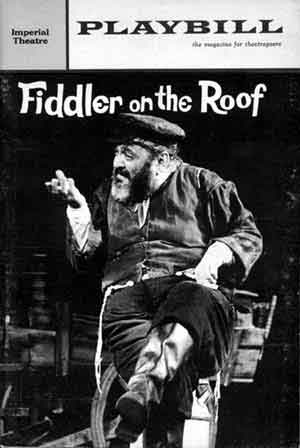 Zero Mostel's Tevye tells God what life would be
"If I Were a Rich Man" in Fiddler on the Roof.
Zero Mostel's Tevye tells God what life would be
"If I Were a Rich Man" in Fiddler on the Roof.
With a brutal winter just ahead, the traditional Broadway musical had a bounteous autumn harvest that stretched from 1964 through 1966. No less than six musicals that opened in this three year period ran for over a thousand performances – an unprecedented crop of long-running hits.
Boasting solid scripts and superb integrated productions, they were the ultimate fulfillments of the post-Oklahoma tradition –
1. Hello Dolly! (1964 - 2, 844 performances) - For details on this show, please see the section discussing Gower Champion on the previous page.
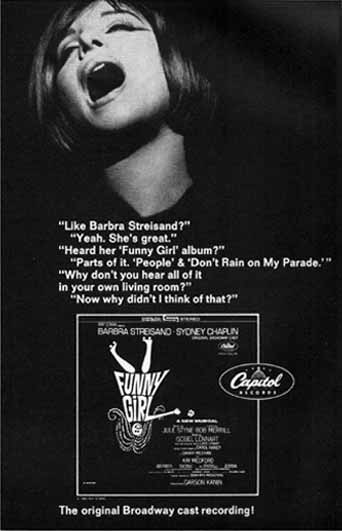
2. Funny Girl (1964 - 1,348 performances) - After torturous previews, multiple directors and extensive rewrites, this fictionalized biography of comedienne Fanny Brice was given some much needed polish by Jerome Robbins. The results made a star of Barbra Streisand, who wisely avoided imitating Brice, building her own fresh characterization and relying on her own distinctive vocal stylings. Composer Jule Styne and lyricist Bob Merrill's brassy score included the hit songs "People" and "Don't Rain on My Parade." The gifted Streisand went off to Hollywood for the screen version, winning an Academy Award for Best Actress. She never appeared in another stage musical.
3. Fiddler on the Roof (1964 - 3,242 performances) - Composer Jerry Bock and lyricist Sheldon Harnick teamed with librettist Joseph Stein for this adaptation of Sholom Aleichem's stories about Tevya, a philosophical dairy farmer who tries to uphold Jewish Orthodox traditions against overwhelming odds in Tsarist Russia. Zero Mostel's powerful but self-indulgent performance in the lead helped establish the show. It then went on to a record-setting run under a long series of fine actors in the role of Tevya.
Audiences the world over identified with this unlikely but ultimately irresistible hit. The much loved score includes "Matchmaker, Matchmaker," "If I Were a Rich Man," and "Do You Love Me?," and "Sunrise, Sunset." The final and arguably the most memorable Broadway staging by Jerome Robbins, it included jubilant wedding celebrants balancing wine bottles on their hats, and a dancing circle of townspeople that embodied the idea of a community coming together and coming apart.
4. Man of La Mancha (1965 - 2,328 performances) - Librettist Dale Wasserman, composer Mitch Leigh and lyricist Joe Darion built a musical around the story of Spanish novelist Cervantes. He is thrown into prison by the Inquisition and tries to save the manuscript for his masterful Don Quixote from destruction by his fellow prisoners -- by enacting it with their assistance.
Richard Kiley scored the greatest triumph of his career in the title role, as did co-star Joan Diener playing the tattered kitchen girl Aldonza. Despite mixed reviews, the show enjoyed long runs everywhere from London to Tokyo, and "Impossible Dream (The Quest)" became an international standard. Director Albert Marre's unpretentious staging was so effective that it was copied by most major professional productions of La Mancha for more than thirty years.
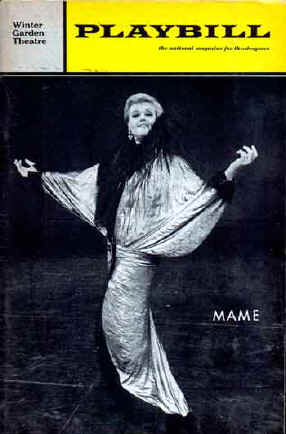
5. Mame (1966 - 1,508 performances) - Jerry Herman followed up his smash Hello Dolly by teaming with playwrights Jerome Lawrence and Robert E. Lee for an adaptation of their long-running comedy Auntie Mame. Angela Lansbury wowed audiences in the title role, winning her first Tony for Best Actress playing the eccentric heiress who liberates her orphaned nephew from a stodgy upbringing. Beatrice Arthur's hilarious performance as the bitchy actress Vera Charles brought her a Tony for Best Featured Actress.
Herman's score included the show-stopping title tune, the moving "If He Walked Into My Life," and the hilarious Lansbury-Arthur duet "Bosom Buddies." Mame proved a worldwide favorite, enjoying successful productions into the next century.
6. Cabaret (1966 - 1,165 performances) - Composer John Kander and lyricist Fred Ebb worked with librettist Joe Masteroff on this searing adaptation of Christopher Isherwood's play I Am a Camera. As a young American writer falls in love with a cabaret singer, we meet seedy chorus girls, Nazi storm troopers, and other denizens of the demi-monde in early 1930s Berlin.
Joel Grey gave an electrifying performance as the leering Master of Ceremonies, a role he repeated in the acclaimed 1972 film version – becoming one of the very few actors to win the Tony and Academy Awards for the same role. The score included "Wilkommen" and the hit title song. Three decades later, an innovative Broadway revival would rack up an even longer run (1998 - 2,398 performances).

With characters and stories that speak to the heart of human experience – offering different perspectives on the search for love and triumph of the human spirit in a harsh world – it is no wonder that these six shows remain among the most frequently performed musicals. But the late 1960s marked a time of cultural upheaval. Young Americans were rocking to a different beat, and the Broadway musical was about to be dragged into a new, uncertain era. The changes would prove painful for many - including those behind the scenes, as well as those in the audience.