
Dance in Stage Musicals - Part II
by John Kenrick
(Copyright 2003)
- Follies I: Julian Mitchell
- Follies II: Ned Wayburn
- Albertina Rasch
- On Your Toes: Balanchine
- Oklahoma: Agnes DeMille
Florenz
Ziegfeld produced the Follies (1907-1931), a series of spectacular
revues "glorifying the American Girl." Three Follies
dance directors (the term "choreographers" was still reserved
for classical ballet) played crucial roles in the redefining the role of
dance on Broadway in the early 20th Century-- Julian Mitchell, Ned
Wayburn and Albertina Rasch.
Ziegfeld Follies I: Julian Mitchell
The earliest editions were staged by Julian Mitchell, a former dancer who became Broadway's first important director and choreographer. At a time when theatrical disciplinarians were rare, he demanded professional behavior from his performers. With shows as varied as the Follies, The Pink Lady and Babes in Toyland, Mitchell did much to redefine Broadway dance standards at the start of the 20th Century.
It was not highly technical choreography, nor did it rely on the drilling or novelty dancing which would later become popular, but it did require some talent and teaching, and there was no place in Mitchell's shows for the old-time 'walker' who filled the rows of the chorus simply to show off her figure. Whether for chorus or for principals, his dances were almost always energetic on the one hand or graceful on the other, with plenty of room kept for the comical . . .
- Kurt Ganzl, The Encyclopedia of Musical Theater (NY: Schirmer, 1994), p. 1000.
Ziegfeld Follies II: Ned Wayburn
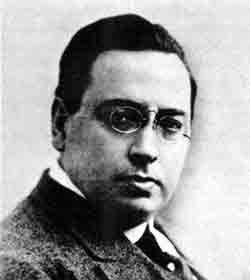 Ziegfeld
Follies dance director Ned Wayburn.
Ziegfeld
Follies dance director Ned Wayburn.
One of Ziegfeld's key collaborators on later editions of the Follies (1916-1925) was dance director Ned Wayburn. This early proponent of precision chorus dancing developed the kick lines and geometric formations that are still familiar in musical staging today. By classifying chorus dancers according to height, Wayburn did much to define the look of the classic Broadway show girl.
Wayburn invented the so-called Ziegfeld Walk, which made it possible for chorus girls to descend stairs in full costume by balancing the forward thrust of each hip with a thrust from the opposite shoulder. Wayburn also developed a crude form of dance notation that made it possible for directors to record basic chorus routines on paper. This allowed his ensemble routines to be maintained or freshly re-created even when he was not present. Wayburn also coined the phrase "tap dancing" when hardshoe dancers added metal taps to their shoes sometime around 1910. Wayburn personally trained many important dancers of his time, including Fred Astaire.
Ziegfeld Follies III: Albertina Rasch
The first important female "dance director," Albertina Rasch brought a classically trained aspect to her Broadway projects. After her first efforts in George White's Scandals (1925), she became part of Ziegfeld's creative team, contributing ballet-inspired dances to Rio Rita (1927), The Three Musketeers (1927), and Show Girl (1929) as well as the 1927 and 1931 editions of the Follies. Although Rasch's dances were designed to appeal to popular tastes, she raised the artistic standard -- whether hoofing or "en point," a dancer was expected to take their work seriously.
"I can always dress them up, but when they have brains -- ah -- but half my battle is won. There are other important qualities that I look for in my young dancers: courage, resourcefulness, good nature and fairness. These are requisites for success in any art, profession or business, but especially in a career as full of wok, disappointments, pleasures, achievements and glories as the life of a dancer."
-Albertina Rasch, as quoted in Richard Kislan's Hoofing On Broadway: A History of Show Dancing (NY: Prentice-Hall, 1987), p. 61.
As respect for dance rose on Broadway, Rasch became one of the first "dance directors" to be referred to as a "choreographer." After The Cat and the Fiddle (1931), she worked on a several historic revues, including The Band Wagon (1931) and Face the Music (1932). Rasch received equal praise for massive ensembles in The Great Waltz (1934) and intimate routines in Jubilee (1935). She was one of the first to treat dance as a serious element in musical theatre, and her routines (still visible in such films as Rosalie and Sweethearts) show a wide range of style.
George Balanchine: On Your Toes
A giant in the world of classical ballet, George Balanchine brought dance in Broadway musicals to a new level with his choreography for Richard Rodger's "Princess Zenobia Ballet" and "Slaughter on 10th Avenue Ballet" in On Your Toes (1936). These extended ballet sequences actually served to develop plot and characterization -- and did so in perfect harmony with the zany musical comedy surrounding them. For example, "Slaughter" is a serious piece depicting a deadly thug fight in a seedy bar, but it ends in uproarious laughter as one of the dancers tries frantically to escape a hail of real bullets. Broadway had never seen the like, and both audiences and critics demanded more.
Balanchine came up with ways to weave dance into the overall fabric of a musical. His dances won acclaim in a stylish revival of The Merry Widow (1943), the long-running operetta Song of Norway (1944), and the musical comedy Where's Charley? (1948). After creating sensual Caribbean dances for the short-lived House of Flowers (1954), Balanchine concentrated entirely on ballet. At the time of his death in 1983, an acclaimed revival of On Your Toes had just opened, showing a new generation the still-dazzling dances that had opened the way for the great choreographers who rose to prominence on Broadway during the mid to late 20th Century.
"Into a choreographic world that was a mélange of decorative movement, legs and taps, Balanchine opened the door and ballet leapt on to the popular musical stage, directed by a supreme artist."
- Alan Jay Lerner, The Musical Theatre: A Celebration. (NY: McGraw Hill, 1986) pp. 137-138.
Agnes DeMille: Oklahoma!
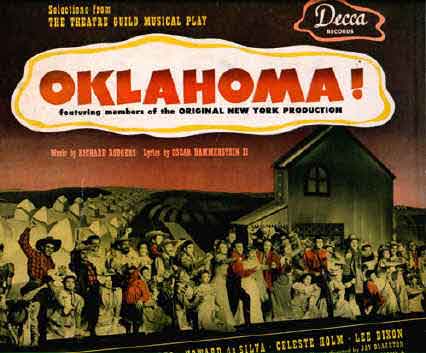 The original cast
sings the rousing ]"Oklahoma!" – as staged by Agnes DeMille.
This is the cover of the innovative original cast recording, first
released on an album of 78 r.p.m. disks.
The original cast
sings the rousing ]"Oklahoma!" – as staged by Agnes DeMille.
This is the cover of the innovative original cast recording, first
released on an album of 78 r.p.m. disks.
Rodgers and Hammerstein's Oklahoma! (1943) signaled an new era for the musical theatre in many ways. One of its most influential innovations was the use of dance as a story telling tool. American ballet choreographer Agnes DeMille created dances that joined the songs and libretto, giving the show a power no other musical comedy had shown before. The all-American story of a cowboy romancing a farm girl touched audiences far beyond US shores. One social commentator described the impact of Oklahoma's London premiere –
Agnes DeMille took the musical out into the Middle West and invented for it a jollier, more masculine style of dancing than the English ever attempted. In Britain, when I was young, a musical had a love-misunderstanding-reunion storyline enacted by a pretty boy and girl while behind them a line of chorus boys and girls did nothing more than link arms and kick their height. When Oklahoma! arrived, the theatre – nay, the whole city – shook.
- Quentin Crisp, as quoted by Max Wilk in OK: The Story of Oklahoma (New York: Grove Press, 1993), p. 245.
DeMille was also the inventor of the "dream ballet," a form that was copied by lesser talents on stage and screen through the 1950s. Thanks in large part to DeMille's success, choreographers moved to a more central position in the musical theatre's creative hierarchy.