
G&S101
The Gilbert & Sullivan Story: Part III
by John Kenrick
Copyright 2000 (Revised 2020)
(All the photos on this page are thumbnails – click on them to see larger versions.)
The Mikado
 The
D'Oyly Carte Company's 1936 film version of The Mikado, with Martyn
Green (center, in black robe) as KoKo.
The
D'Oyly Carte Company's 1936 film version of The Mikado, with Martyn
Green (center, in black robe) as KoKo.
As a follow-up to Princess Ida, Gilbert offered yet another plot involving a love potion, and when Sullivan balked at this throwback to The Sorcerer, the disagreement turned ugly. Sullivan declared that it was time for him to concentrate on more serious compositions, and Gilbert resented the suggestion that their collaboration was somehow holding Sullivan back.
D'Oyly Carte staged a revival of The Sorcerer to keep the company going, and found all attempts at reconciling his partners to be in vain. The partnership was on the brink of collapse when a decorative Japanese sword fell from the wall of Gilbert's study, nearly landing on his head – and inspiring the plot for the most popular show in the G&S canon.
The Mikado (1885 - 672 performances London) reflected an 1880s British craze for “all things Japanese.” The complicated plot centers on what happens when a fictional Emperor of Japan decrees that flirting is punishable by death. Because no one in the town of Titipu is willing to enforce this horrible law, a condemned tailor (Koko) is appointed Lord High Executioner – the reasoning being that he cannot behead anyone until he beheads himself. When it turns out he has to execute someone after all, he selects Nanki-Poo, a handsome traveling minstrel. Nanki-Poo will only agree to the scheme if he can first marry the executioner's ward and finance, the lovely Yum-Yum. This would allow the minstrel a month of marital bliss, after which the Executioner can behead the lad and marry his ward as originally planned.
However, Katisha, an aged royal courtier appears, announcing that Nanki-poo is actually the crown prince who flirted with her and has been in hiding ever since! The Mikado soon arrives to proclaim that his "object all sublime" is "to let the punishment fit the crime." After a series of deceptions and misunderstandings, no one dies and everything is resolved.
The Mikado's setting and costumes were Japanese, but audiences knew that it was a send-up of British social customs and pretensions. “Three Little Maids From School,” “A Wand'ring Minstrel I” and “Titwillow” were sung everywhere. In the United States, The Mikado was the only G&S operetta to repeat the impact of H.M.S. Pinafore, as "Mikado-mania" fed a new American passion for all things Japanese.
The Mikado has been widely performed in languages other than English -- including French, German and even Yiddish. It is also one of the few stage musicals that ever caused a diplomatic fracas. When the Crown Prince of Japan made a state visit to England in 1907, the work was temporarily banned by the British government -- a maneuver that backfired when the prince complained that he had hoped to see The Mikado during his stay. After more than 120 years, it remains one of the most frequently performed musicals of all time, and still receives frequent amateur and professional stagings worldwide.
Living up to The Mikado
Few things are more difficult than trying to follow-up on a mammoth success. Gilbert and Sullivan's melodramatic spoof of gothic horror Ruddigore or The Witch's Curse (1887 - 288 performances London) had its charms, with a fine score and a well crafted story. But many complained that it was not another Mikado. (As if anything could be?) Sullivan once again grumbled that he should be working on more serious compositions.
Gilbert enticed Sullivan with a libretto unlike any other in the series. Set in the Tower of London during the reign of Henry VIII, The Yeomen of the Guard (1888 - 423 performances London) had political intrigue and the threat of execution overshadowing the tale of a jester competing with a nobleman for the love of a beautiful girl. Yeoman gave Sullivan the opportunity to compose his most melodically ambitious Savoy score, and Gilbert's script had little trace of his usual "topsy-turvy" humor. The most serious of Gilbert and Sullivan's collaborations, it was Sullivan's personal favorite.
 The team resumed their comic ways with The Gondoliers
(1889 - 554 performances London), the story of two anti-royalist Venetian gondoliers
who find themselves the jointly-reigning kings of a revolution-torn
country. G&S had tremendous fun with the comparative foibles of
monarchy and democracy, and the show became a massive hit on both sides of the
Atlantic. The reclusive Queen Victoria invited the
D'Oyly Carte company to give several private performances of this hit,
including a memorable Gondoliers at Windsor Castle (pictured in the thumbnail at
left).
The team resumed their comic ways with The Gondoliers
(1889 - 554 performances London), the story of two anti-royalist Venetian gondoliers
who find themselves the jointly-reigning kings of a revolution-torn
country. G&S had tremendous fun with the comparative foibles of
monarchy and democracy, and the show became a massive hit on both sides of the
Atlantic. The reclusive Queen Victoria invited the
D'Oyly Carte company to give several private performances of this hit,
including a memorable Gondoliers at Windsor Castle (pictured in the thumbnail at
left).
These performances confirmed the new respectability Gilbert and Sullivan had brought to the musical theatre. No doubt Her Majesty particularly enjoyed a quartet in which the gondoliers and their fiances sing of what a glorious thing it is "to be a regular royal queen." It was a blatantly affectionate comic tribute to the woman who had ruled Britain for more than half a century.
just when it seemed Gilbert and Sullivan's collaboration was at its peak, it fell apart over several trivial disputes – including an infamous quarrel over the price of some new carpeting in the Savoy Theatre. When Gilbert furiously claimed that he had been overcharged for his share, Sullivan sided with D'Oyly Carte. Carte then produced Sullivan's long awaited grand opera Ivanhoe, which Gilbert had no hand in -- and which proved to be a costly failure. Gilbert, who most scholars feel had made a huge fuss over nothing, resumed writing plays -- which didn't fare much better.
After several years, the Savoy trio effected a reconciliation, but things were never quite the same. Utopia Limited (1893 - 245 performances London) made fun of Britain's attempts to take over distant nations and remake them in its own image, and The Grand Duke (1896 -123 performances London) had a theatrical troupe trying to seize power in a tottering German principality. While both works were melodic and entertaining, the public felt these works were just more of what they had seen from the team before. As a result, neither show ran long enough to cover high production costs. It seemed that Gilbert and Sullivan were losing the fresh creative edge that had enlivened their previous works.
Curtain Calls
 Gilbert reading the libretto
of Utopia Limited to the cast on the
first day of rehearsal at The Savoy Theatre in London.
Gilbert reading the libretto
of Utopia Limited to the cast on the
first day of rehearsal at The Savoy Theatre in London.
Gilbert and Sullivan remained on cordial terms in their final years, and ongoing revivals of their hits brought them fresh acclaim. Sullivan received a knighthood in 1888, and the old collaborators shared curtain calls whenever revivals of their hits opened at the Savoy. Sullivan continued to write comic operas with new librettists, including the well-received Emerald Isle (1900), but none matched the popularity of the Savoy classics. Weakened by years of kidney trouble and other chronic ailments, he succumbed to a severe case of bronchitis in 1900, dying at age 58.
Gilbert enjoyed renewed health and popularity in the new century, writing plays and musical librettos, receiving his knighthood in 1907. He even had the satisfaction of living long enough to be acclaimed as what he was – a British national treasure. In late May 1911, Gilbert (at age 74) suffered a fatal heart attack while saving a young woman from drowning on his country estate.
After many years of illness, Richard D'Oyly Carte died in 1901. The D'Oyly Carte Opera Company continued under the management of his wife Helen, then later his son Rupert and granddaughter Bridget, reviving the best of G&S through most of the 20th century. Financial woes forced the company to shut down in 1983, but thanks to seed money left by Bridget, a "new" D'Oyly Carte organization was soon formed. Although the founding family is no longer in charge, the company continues to stage popular revivals of the G&S cannon in Britain.
The G&S Legacy in Britain
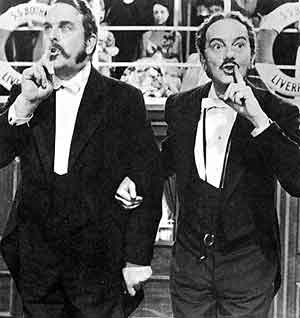 Robert
Morley as Gilbert and Maurice Evans as Sullivan in the British screen bio The
Gilbert & Sullivan Story.
Robert
Morley as Gilbert and Maurice Evans as Sullivan in the British screen bio The
Gilbert & Sullivan Story.
The works of G&S have remained popular with all levels of British society for more than a hundred years – an extraordinary achievement in one of the world's most openly class-conscious cultures. Professional and amateur groups still perform the canon throughout the British Empire and the United States.
Thanks in large part to the works of Gilbert and Sullivan, the British public's affection for popular music became stronger than ever. Noel Coward gives us a sense of what it was like to grow up in Britain at the start of the 20th century –
"I was born into a generation that still took light music seriously. The lyrics and melodies of Gilbert and Sullivan were hummed and strummed into my consciousness at an early age. My father sang them, my mother played them, my nurse, Emma, breathed them through her teeth while she was washing me, dressing me and undressing me and putting me to bed. My aunts and uncles, who were legion, sang them singly and in unison at the slightest provocation."
- The introduction to The Noel Coward Song Book (London: Methuen, 1953), p. 9.
The D'Oyly Carte family retained exclusive British production rights to all the Gilbert & Sullivan operettas through the 1950s. While this arrangement encouraged ongoing interest in the works and helped to develop a solid G&S "tradition," it also limited the ways in which these musical could be produced and performed.
"What can be confidently said is that the combination of the "tradition" and D'Oyly Carte exclusivity kept several generations of performers, conductors and directors from bringing their gifts to Gilbert and Sullivan. We will never know what Noel Coward might have brought to the role of Sir Joseph Porter, for example, or how Charles Laughton might have played Wilfred Shadbolt. Julie Andrews never sang Josephine or Mabel. Sir Thomas Beecham never conducted Yeomen of the Guard . . . we can only speculate on what was lost."
- Gayden Wren, A Most Ingenious Paradox: The Art of Gilbert and Sullivan (New York: Oxford University Press, 2001), pp. 292-293.
It is almost impossible to estimate the influence G&S had on the development of musical theatre, both as a business and as an art form, in Britain and the United States. Thanks to them, the musical theatre was redefined forever. The changes were many . . .