
The Merry Widow 101
History of a Hit
by John Kenrick
Copyright 2004
Vienna's definitive romantic operetta almost never happened. In fact, disaster loomed over several stages of the show's development. The history of The Merry Widow is clear proof of how fine the line between success and oblivion can be.
Vienna 1905
Today, Vienna is a popular tourist destination, the elegant capital of a peaceful republic. But in 1905, it was one of the world's busiest financial and cultural centers, and the capital of Austria-Hungary, a polyglot empire with over 50 million inhabitants, the second largest nation in Europe. The Hapsburg dynasty had governed this unruly confederation since the 13th Century. Emperor Franz Joseph had been on the throne since 1848, and at age 75 commanded enough public affection to keep the empire functioning, despite the occasional stumbles of a massive and often corrupt bureaucracy. Nationalists and political extremists pulled from all sides. In 1905, when a revolutionary crisis in Russia inspired renewed calls for reform in Austria-Hungary, Franz Joseph granted a portion of his subjects voting rights. In years to come, he did his best to turn back time, but increasing discontentment gradually turned the empire into what one historian has called "a madhouse of nationalities."
Despite the political turmoil, the Viennese clung to their intellectual and artistic pursuits, finding comfort in their coffee mitt schlag ("with cream"), sacher torte and their native brand of romantic comic operetta. As a major banking and business center, Vienna had ample resources, and a sizeable population with the leisure time and money to support the arts, including several fulltime operetta theatres, some of which remain active to this day. And while Vienna welcomed its share of revivals, theatergoers expected and got a constant flow of original works. At the start of the 20th Century, the latest Viennese hits often traveled to Berlin, London and New York, so there was a constant demand for new ideas and fresh talent.
The Beginning: The Ambassador's Attache
Henri Meilhac, best remembered as the co-librettist for many of Offenbach's hits, was also a prolific playwright. His now-forgotten French comedy L'Attache d'ambassade (1861) (trans: "The Embassy Attaché") involved Baron Scharpf, the Parisian ambassador of an impoverished German duchy, who must orchestrate a marriage between his country's richest widow, Madeline von Palmer, and embassy attaché Count Prachs -- thus preventing economic disaster back at home. The original Paris production at the Theatre du Vaudeville faded away after 15 performances, but Vienna's Carltheater staged a German adaptation by Alexander Bergen, and Der Gesand schafts Attache (1862) enjoyed a profitable run and was periodically revived. It was either one of these revivals or a chance encounter with a copy of the script in early 1905 that caught the attention of veteran librettist Leo Stein in 1905 He thought the forty-year old comedy could be turned into a successful operetta, and brought the idea to his occasional collaborator Victor Leon.
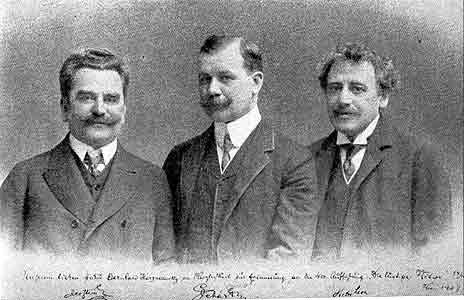 Franz Lehar, Leo Stein and Victor Leon -- the creators
of Die Lustige Witwe -- as they appeared on a 1908 postcard.
Franz Lehar, Leo Stein and Victor Leon -- the creators
of Die Lustige Witwe -- as they appeared on a 1908 postcard.
The prestigious Theater An der Wein was reeling from a series of expensive failures. They had not had a major new hit since Der Opernball (1898), a bit of fluff about three Parisian men flirting behind their wives' backs. The melodic score by composer Richard Heuberger and libretto co-authored by Leon had gone on to international success. Theater manager Wilhelm Karczag was looking for a new operetta with a similar Parisian setting, so a musical version of Der Gesand schafts Attache sounded like it might be just what he needed.
The Plot
Leon and Stein updated the story line to their own time, the dawn of the 20th Century, and came up with the provocative title Die Lustige Witwe (The Merry Widow). The action opens during a gala reception at the Parisian embassy of Pontevedro, a fictional Eastern European kingdom reminiscent of Montenegro. Ambassador Mirko Zeta is oblivious to the flirtation between his much younger and supposedly "virtuous" wife Valencienne and the handsome French aristocrat Camille de Rosillon. Mirko knows that his fatherland faces bankruptcy if its richest citizen, the young widow Hanna Glawari, should marry a foreigner. Zeta orders his attaché, Count Danilo Danilowitch, to ward off the money hungry horde of potential suitors swarming around the wealthy beauty.
The librettists added a new dimension to the existing story -- Hannah and Danilo are not exactly strangers. It seems that they had a torrid affair when Hannah was a poor farm girl, but Danilo's royal uncle would not let him marry a penniless commoner. As a precaution, Danilo was bundled off to Paris, where he finds inebriated consolation among the dancing girls ("grisettes") at Maxim's. Soon afterwards, Hannah caught the eye of the wealthy Herr Glawari, who married her and then conveniently died on their honeymoon, leaving her all of his "twenty millions". When Hannah and Danilo meet again after all these years, she teasingly suggests that her fortune now makes her easier to love . Danilo refuses to be classified as a fortune hunter. So, Hannah and Danilo are stuck -- both in love and both unwilling to admit it.
In the second act, the Widow throws a Pontevedrian costume party at her Paris mansion. When Camille and Valencienne are caught during a rendezvous in the garden pavilion, Hannah gallantly takes Valencienne's place. To assuage the Ambassador's suspicions, Hannah announces that she and Camille are engaged, and a jealous Danilo storms off to Maxim's and his beloved grisettes.
For the third act, the Widow turns her home into a replica of Maxim's, hiring out the waiters and grisettes for the evening -- knowing this will lure Danilo back. When he arrives and confronts Hannah, she tells him that the engagement was all a bluff, and that she must lose her entire fortune if she remarries. They finally admit their mutual love while singing and dancing a sensual waltz. Valencienne manages to reassure Ambassador Zeta of her fidelity, and Hannah admits she will lose her fortune -- because every cent will go to her next husband.
Franz Lehar
Heuberger went to work on the score, but it seems that his heart was never completely in it. Theater An Der Wien's manager, Wilhelm Karczag, was so disappointed when he heard the results that (to Heuberger's relief) he took back the libretto. Karczag wanted to scrap the project until his secretary, Emil Steininger, suggested that they offer the libretto to composer Franz Lehar. The son of a military band master, Lehar had once served as the theatre's orchestra leader and had already worked with Leon & Stein on the hit Der Rastelbinder (1902) and the less successful Der Gottergatte (1904).
Leon openly doubted that the ever-so-Viennese Lehar could invoke believeable Parisian atmosphere. Within hours of receiving the libretto, Lehar presented the producer with the bubbly gallop tune for "Dummer, dummer Reitersmann" -- usually translated as "Silly, silly Cavalier." Supposedly, all reservations were swept aside, even though it is difficult to say what qualified this particular melody as "Parisian." Lehar spent the summer of 1905 working with Leon & Stein, and the score was ready by that fall. After minor delays, the premiere of Die Lustige Witwe was scheduled for late December.
Rehearsals & Worries
The Theatre An der Wien's treasury had been depleted by a series of recent failures, so the management kept their investment in Die Lustige Witwe to a minimum by using recycled costumes and sets. Instead of openly mentioning Meilhac's original play (which would have forced them to pay rights fees), their program notes described the plot as "partly based on a foreign idea."
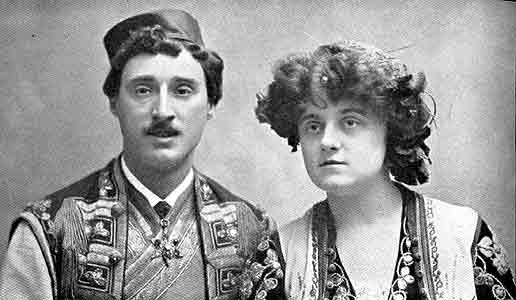 The
secondhand production was blessed with a first-rate cast.
Soprano Mizzi Gunther and
baritone Louis Treumann (both seen
in the photo on the right) were the first
choices to fill the roles of widow Hannah
Glawari and her once and future lover, Count Danilo. They had previously
co-starred in both Der Opernball and Der Rastelbinder. While
neither performer was strikingly attractive, onstage their chemistry
struck a tasteful balance of propriety and passion.
The
secondhand production was blessed with a first-rate cast.
Soprano Mizzi Gunther and
baritone Louis Treumann (both seen
in the photo on the right) were the first
choices to fill the roles of widow Hannah
Glawari and her once and future lover, Count Danilo. They had previously
co-starred in both Der Opernball and Der Rastelbinder. While
neither performer was strikingly attractive, onstage their chemistry
struck a tasteful balance of propriety and passion.
Like their composer, the two stars firmly believed Die Lustige Witwe would succeed. Gunther paid for her own lavish costumes, and Treumann ordered a costly replica of a real royal dress uniform. As rehearsals progressed, the producers became increasingly pessimistic that Lehar's innovative use of orchestral coloring (usually reserved for more serious compositions) would meet with public approval. At one point, theatre manager Karczag offered Lehar five thousand crowns to shut down the production. The composer refused, but such tactless maneuvers must have added to everyone's pre-opening jitters.
The Premiere
Die Lustige Witwe premiered at the Theatre an der Wien on the evening of December 30, 1905 with the following leads --
- Hanna Glawari - Mizzi Gunther
- Count Danilo - Louis Treumann
- Valencienne - Annie Wunsch
- Camille de Rosillon - Karl Meister
- Baron Mirko Zeta - Siegmund Natzler
 Contrary
to popular misconception, the original production was a tremendous
success.
Business was a bit shaky for the first month or so, but word of mouth
soon brought packed houses. Medleys performed in Vienna's cafes and concert
halls added to the furor. In those years before air conditioning, Theatre an
der Wein always shut down for the summer. Due to the ongoing demand for tickets,
Die Lustige Witwe transferred to the airier suburban Raimuntheater,
then the prestigious Volksoper, selling out all along the way.
Contrary
to popular misconception, the original production was a tremendous
success.
Business was a bit shaky for the first month or so, but word of mouth
soon brought packed houses. Medleys performed in Vienna's cafes and concert
halls added to the furor. In those years before air conditioning, Theatre an
der Wein always shut down for the summer. Due to the ongoing demand for tickets,
Die Lustige Witwe transferred to the airier suburban Raimuntheater,
then the prestigious Volksoper, selling out all along the way.
The production returned to the Theater an der Wien in the fall, a hotter ticket than ever. When the show reached its 300th consecutive performance, the management finally invested in new sets and costumes. Lehar marked the 400th performance by adding an overture -- which was eventually shelved. Most productions have instead used Lehar's original prelude which brought the curtain up after a few bars of bouncy melody.